The Evening Belonged to You: How Work Learned to Follow You Home
At some point in the mid-2000s, millions of American workers crossed a threshold they didn't know they were crossing. Their employers handed them BlackBerries — or paid for data plans on their personal phones — and in that moment, with the best of practical intentions, the boundary between working hours and personal time began to dissolve.
It happened fast. It happened quietly. And it turned out to be one of the most significant changes to everyday American life in the past half-century.
When 5 O'Clock Actually Meant Something
To understand what changed, it helps to understand what the old arrangement actually looked like — not in a romanticized way, but practically.
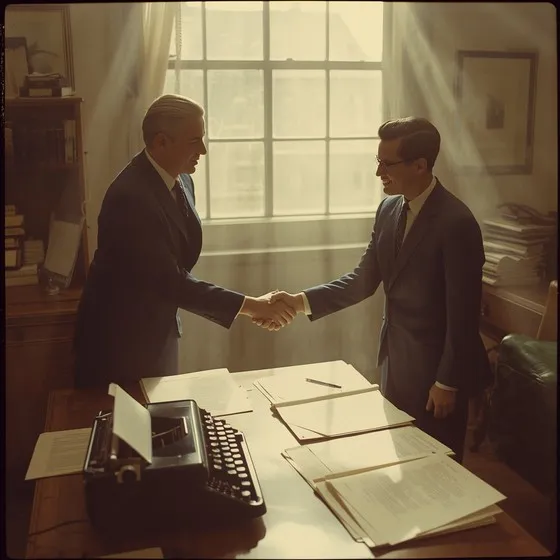
For most office workers through the 1960s, '70s, and '80s, work had a clear physical address. It happened at a desk, in a building, during specific hours. When you left that building, the work stayed behind — because it had to. Your files were in the filing cabinet. Your phone was on your desk. Your colleagues could reach you during business hours, and after that, they would wait.
This wasn't a perk or a negotiated benefit. It was simply how the infrastructure worked. There was no mechanism for your manager to send you a document at 9pm. There was no way for a client in another time zone to expect a response before morning. The technology enforced a separation that nobody had to consciously maintain.
And inside that separation, evenings were genuinely yours. Dinner wasn't interrupted by notifications. Weekends didn't carry the low-grade anxiety of an unread inbox. The mental decompression that happens when you physically leave a space — when you drive home and the building recedes in the mirror — had time to actually complete.
The Pager, the BlackBerry, and the Slow Invasion
The erosion started before smartphones. Pagers in the 1980s introduced the idea that certain workers — doctors, executives, people in time-sensitive industries — could be reached anywhere. But pagers were understood to be exceptional tools for exceptional situations. They signaled urgency. You didn't page someone to ask about a spreadsheet.
Email changed the calculus in the 1990s. At first, most people checked it at work, on work computers, during work hours. The inbox was still located somewhere specific. But as home internet spread and laptops became affordable, the inbox followed people home — and with it came the unspoken expectation that checking it was now a reasonable after-hours activity.
The BlackBerry, dominant in corporate America through the mid-2000s, collapsed the last wall. Now email was in your pocket, delivering a small vibration every time something arrived. The device became so associated with compulsive after-hours checking that it earned the nickname "CrackBerry" — a joke that also happened to be a fairly accurate description of the behavioral loop it created.
Then the iPhone arrived in 2007, and within a few years, the smartphone was universal. Slack, Teams, and a dozen other messaging platforms layered on top of email, each with their own notification systems and their own implicit expectations about response time. The boundary didn't just blur — it largely ceased to exist as a structural feature of work.
What the Data Actually Shows
The consequences were measurable, and they weren't subtle.
A study published in the American Journal of Preventive Medicine found that checking work email after hours was significantly associated with higher levels of stress and lower levels of psychological detachment from work — which is the technical term for the mental process of actually unwinding. You can't fully decompress if part of your brain is monitoring a channel that might require a response.
The National Institute for Occupational Safety and Health has identified chronic overwork and blurred work-life boundaries as meaningful contributors to burnout, cardiovascular risk, and mental health challenges. The US, which has no federal legal requirement for employers to respect after-hours communication (unlike France, which enacted a legal "right to disconnect" in 2017, or Portugal, which banned after-hours work contacts in 2021), has been particularly exposed to these effects.
A 2021 survey by the Society for Human Resource Management found that 41% of US remote workers reported working longer hours than they did before the pandemic — not because they were required to, but because the absence of a physical office made it structurally harder to stop.
Did Remote Work Make It Better or Worse?
The COVID-19 pandemic forced a mass experiment in remote work, and many observers predicted it might restore the separation that smartphones had eroded — after all, if home and office were the same place, the commute was gone and the schedule could flex.
The reality was more complicated. For some workers, especially parents who could adjust their hours around family needs, remote work did offer a meaningful improvement in daily quality of life. The flexibility was real.
But for many others, working from home meant working from everywhere, always. Without the physical act of leaving a building, the psychological signal that the workday had ended was gone. Meetings crept into early mornings and late evenings to accommodate distributed teams. The blurred boundary didn't sharpen — it disappeared entirely for some people.
Hybrid work, now the dominant model for office-based employees in the US, has produced mixed results. The days spent in an office can restore some structure, but the days at home often replicate the always-on dynamic. The smartphone remains in the pocket regardless.
The Cost Nobody Fully Calculated
There's a financial dimension to this that rarely gets discussed plainly: a significant portion of the productivity gains employers extracted from always-on culture came from unpaid labor. When workers answer emails at 8pm, they're working. When they respond to Slack messages on Sunday morning, they're working. The technology that made this possible also made it invisible — it didn't look like overtime, so it didn't get treated as overtime.
Economists estimate that American workers perform billions of hours of unpaid after-hours work annually. The exact figure is difficult to calculate precisely because the work is so embedded in everyday life that workers themselves often don't count it. You don't clock out to check your phone.
What a Clean Break Was Worth
The evening that used to belong to you wasn't just pleasant. It was functional. It was when your brain processed the day, when your stress hormones recalibrated, when your relationships with the people you lived with got the attention they needed. It was when you were, in the most straightforward sense, a person rather than an employee.
The technology that erased that boundary was sold as convenience and connectivity. And in many ways, it delivered on that promise. But it also extracted something that had real value — something most people didn't think to protect until it was already gone.
The clock delta between then and now isn't measured in minutes. It's measured in evenings.