Your Word Was the Contract: The America That Ran on Reputation

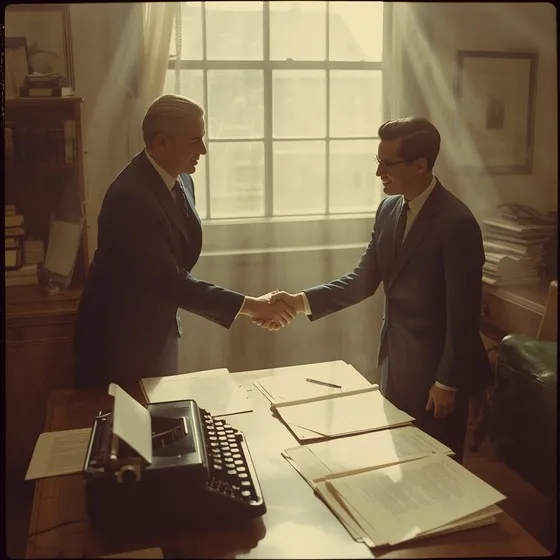
Somewhere in a storage unit in rural Ohio, there is almost certainly a family farm that changed hands on a handshake. No title company, no escrow, no thirty-page purchase agreement reviewed by two attorneys. Two men stood in a field, one agreed to sell, one agreed to buy, they shook hands, and that was that. The deal held. It held because it had to — because in the world those men lived in, breaking your word wasn't a legal problem. It was a social death sentence.
That world is gone. But understanding how it worked — and why it worked — says something important about what we've built in its place.
The Enforcement Mechanism Nobody Talks About
When people romanticize the era of verbal agreements and handshake deals, they tend to focus on the trust. What they underestimate is the infrastructure behind that trust. It wasn't naive. It wasn't sentimental. It was a brutally effective system of social accountability that made written contracts largely unnecessary for most transactions.
In a small town or a tight-knit business community, your reputation was a financial asset — one that took years to build and could be destroyed in an afternoon. If you welched on a deal, the hardware store owner heard about it. The banker heard about it. Your neighbors heard about it. The next time you needed credit, a favor, or a business partner, you were starting from a serious deficit. There was no fresh start, no new city to move to where nobody knew the story. You lived with the consequences in real time, among real people.
This is what economists call a repeated-game dynamic. When you know you'll be dealing with the same people again — next season, next year, next decade — the incentive to honor your commitments is enormous. Defection is expensive. Reputation is currency. The handshake worked because the community was the enforcement mechanism.
When Deals Went to Paper
Contracts aren't new. Merchants in ancient Mesopotamia used clay tablets to record transactions. Medieval guilds had elaborate written codes. American commerce has always had lawyers. But for most everyday business between individuals — loans between neighbors, agreements between farmers, deals struck at the local diner — written contracts were the exception rather than the rule well into the twentieth century.
What changed wasn't human nature. What changed was scale. As American business expanded beyond local communities, the repeated-game dynamic broke down. You weren't selling to your neighbor anymore; you were selling to a customer in another state who you'd never meet again. The social enforcement mechanism that made handshake deals reliable simply didn't exist at that distance.
Contracts filled the gap. They moved enforcement from the community to the court system — a slower, more expensive, but geographically unlimited alternative. It was a reasonable trade. It allowed commerce to scale in ways that community-based trust never could have.
But the trade had a cost that doesn't always make it onto the ledger.
The Paperwork That Replaced Judgment
The modern contract economy is, in many respects, a triumph of legal engineering. But it has also produced something that would have baffled previous generations: a world in which people routinely agree to things they haven't read and couldn't understand if they tried.
The average American encounters dozens of binding agreements every year — software terms of service, app permissions, mortgage disclosures, employment agreements, credit card contracts. The combined length of the terms-of-service agreements for the major platforms most Americans use daily runs to hundreds of thousands of words. Nobody reads them. Everybody signs them, or clicks the button that functions as a signature.
There's a dark irony here. The verbal agreement era demanded that you actually understand what you were agreeing to, because you had to be able to explain it to your community if it went sideways. The written contract era, which was supposed to produce more clarity and accountability, has produced documents so complex that the average person has less understanding of their obligations than their great-grandfather did when he shook hands in a field.
What Trust Actually Required
It's worth being honest about the limits of the handshake era. The social enforcement mechanisms that made verbal agreements reliable also had a dark side. They worked best for people who were already inside the community — who looked the right way, knew the right people, attended the right church. For those on the outside, the same system that protected insiders could be used to exclude, exploit, or ignore them with no legal recourse.
The formalization of contracts, and the legal system that backs them, extended at least the theoretical protection of enforceable agreements to people who would never have had access to the handshake economy. That's a real and meaningful improvement.
But the best version of the old system — the one built on genuine relationship, mutual accountability, and the understanding that your word was the most valuable thing you owned — that part deserves some mourning. Because what replaced it isn't just more formal. It's more anonymous, more adversarial, and in many ways, more fragile.
A handshake held because two people had to look each other in the eye afterward. A terms-of-service agreement holds because one party has enough lawyers to make fighting it not worth your time. Those are not the same thing, and we should probably stop pretending they are.