The Death of the Know-It-All Salesman: When Buying Anything Meant Meeting an Expert
Walk into any big-box electronics store today and you'll likely encounter a teenager in a polo shirt who knows less about the products than you do. Ask about camera specifications, and they'll read the same spec sheet you could have found online. Inquire about audio equipment, and they'll suggest "whatever's popular."
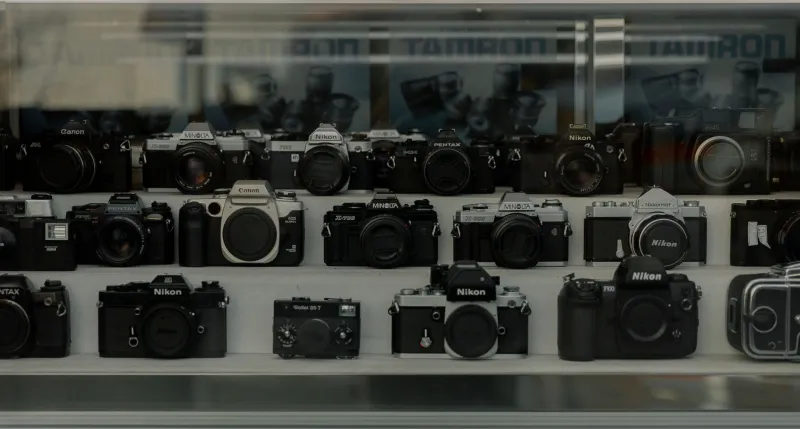
Fifty years ago, buying a camera meant visiting Harold's Camera Shop and talking to Harold himself—a man who had used every camera in his store, understood the subtle differences between lens manufacturers, and could spend an hour explaining why the Nikon would be perfect for your daughter's journalism major while the Canon better suited your landscape photography hobby.
 Photo: Harold's Camera Shop, via webneel.com
Harold wasn't just a salesman. He was a human database, curator, and consultant rolled into one.
The Era of Specialized Knowledge
Before the internet flattened commerce into infinite scroll sessions, American retail was built around expertise. Every category had its specialists: the hi-fi shop owner who could explain why a particular turntable would bring out details you'd never noticed in your favorite albums. The hardware store clerk who knew which screws worked best with which materials and could recommend the right tool for your specific project. The sporting goods expert who understood the difference between tennis rackets designed for power versus control.
These weren't just people who happened to work in stores. They were enthusiasts who had turned their obsessions into careers.
"My father owned a stereo shop in Minneapolis from 1965 to 1995," recalls Jennifer Walsh, whose father's store was a destination for serious audiophiles across the Twin Cities. "He didn't just sell equipment—he was like a matchmaker between people and sound systems. He'd ask about your living room size, your music preferences, your budget, even your neighbors' tolerance for bass. Then he'd put together a system that was perfect for your specific situation."
This personalized approach extended far beyond high-end purchases. The local pharmacy had a pharmacist who knew your family's medical history and could spot dangerous drug interactions. The camera shop owner understood which film stocks worked best for different lighting conditions. The bicycle shop mechanic could recommend the right bike based on your commute, your fitness level, and your long-term cycling goals.
The Birth of Self-Service Everything
The transformation began gradually in the 1980s and 90s with the rise of big-box retailers. Stores like Best Buy and Home Depot offered lower prices by reducing labor costs, including the cost of knowledgeable salespeople. The trade-off seemed reasonable: slightly less expertise in exchange for significantly lower prices.
But the real revolution came with the internet. Suddenly, consumers had access to more product information than any single salesperson could possibly know. Review sites like Amazon and specialized forums created new sources of expertise—crowdsourced knowledge that seemed more trustworthy because it came from actual users rather than people trying to make a sale.
"Why talk to a salesperson when you can read 500 reviews from people who actually own the product?" became the conventional wisdom.
This shift fundamentally changed the relationship between buyers and sellers. Instead of relying on a trusted expert to guide their decisions, consumers became researchers, spending hours comparing specifications, reading reviews, and watching YouTube videos to educate themselves about products they'd never used.
What Reviews Can't Tell You
The crowdsourced review system has obvious advantages. You can read opinions from hundreds of people who've actually used a product in real-world conditions. You can spot patterns in complaints or praise. You can find detailed comparisons that no single salesperson could provide.
But reviews have limitations that specialized salespeople didn't. They can't ask you clarifying questions about your specific needs. They can't demonstrate subtle differences between similar products. They can't provide the kind of contextual advice that comes from years of experience matching products to people.
"I bought a camera online based on amazing reviews," says David Kim, a photographer in Portland. "Technically, it was everything the reviews said it would be. But it was completely wrong for the type of photography I actually do. A good camera shop would have figured that out in five minutes of conversation."
The algorithmic recommendations that replaced human expertise also have blind spots. Amazon's "customers who bought this also bought" suggestions are based on purchase patterns, not actual compatibility or user satisfaction. They might recommend a lens that's technically compatible with your camera but completely inappropriate for your skill level or intended use.
The Economics of Expertise
The decline of specialized salespeople wasn't just about consumer preference—it was driven by economic forces that made expertise increasingly expensive. Knowledgeable employees command higher wages. Training staff requires significant investment. Maintaining deep product knowledge across rapidly changing technology categories became nearly impossible.
Meanwhile, consumers demonstrated that they were willing to trade expertise for convenience and price. Online retailers could offer lower prices partly because they didn't need to employ camera experts or audio specialists in every location.
"The economics just stopped working," explains retail analyst Mark Stevens. "When customers can research everything online and then buy based primarily on price, it's hard to justify paying for expertise that many customers don't seem to value."
This created a vicious cycle: as stores reduced their investment in knowledgeable staff, customers had more reason to do their own research online. As customers became more self-sufficient, stores had even less incentive to invest in expertise.
The Hidden Costs of DIY Research
What we gained in the transition—lower prices, vast selection, detailed reviews—is obvious. What we lost is harder to quantify but equally real.
Consumers now spend countless hours researching purchases that a knowledgeable salesperson could have resolved in minutes. The "analysis paralysis" of too many choices, too many reviews, and too many conflicting opinions has become a standard part of the shopping experience.
More importantly, we lost the serendipity of expert recommendations. A good salesperson might have introduced you to a product category you'd never considered, or explained how two seemingly unrelated purchases could work together in ways you hadn't imagined.
"I discovered my love for vinyl records because the guy at the stereo shop convinced my dad to buy a turntable along with our new speakers in 1978," remembers music producer Lisa Chen. "He said we'd regret not having the option to play records. He was completely right, but I never would have thought to research turntables on my own."
The Persistence of Expertise
Not all specialized retail knowledge has disappeared. High-end audio stores still employ serious audiophiles. Independent bike shops maintain staff who understand the nuances of different riding styles. Specialty camera stores—the few that survive—continue to offer expertise that online retailers can't match.
But these are increasingly niche markets serving enthusiasts willing to pay premium prices for expert guidance. For mainstream consumers buying mainstream products, the era of the knowledgeable salesperson is largely over.
Some online retailers have tried to bridge this gap. Companies like Crutchfield employ specialists who can provide phone consultations about complex purchases. Some websites offer chat features with product experts. But these interactions lack the immediacy and personal touch of face-to-face consultation with someone who knows both the products and the local market.
What We're Still Learning
The shift from expert-guided to self-directed purchasing represents one of the most significant changes in American retail in the past fifty years. We've gained unprecedented access to information and dramatically lower prices. But we've also lost something valuable: the human expertise that could translate technical specifications into practical recommendations.
The question isn't whether this change was inevitable—it probably was. The question is whether we can find new ways to access expertise when we need it, without returning to the limited selection and higher prices of the old model.
Some companies are experimenting with hybrid approaches: online retailers that employ specialists for complex categories, or apps that connect consumers with experts for specific questions. But so far, nothing has fully replaced the comprehensive, personal service that specialized salespeople once provided.
As we continue to navigate this transformation, it's worth remembering what we traded away when we optimized for price and convenience: the irreplaceable value of talking to someone who really, truly knew their stuff.