Red Light, Chemical Magic: The Forgotten Craft of the Home Darkroom
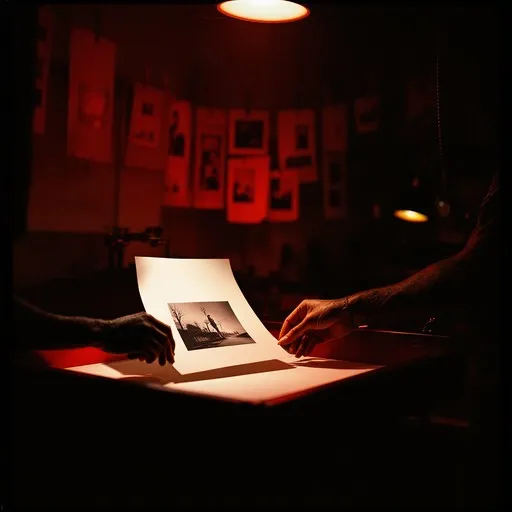
Photo: vintage darkroom photography red safelight developing prints black and white, via images.stockcake.com
Somewhere in suburban America, circa 1978, a father is standing in his bathroom at eleven o'clock at night. The door is sealed with a towel at the bottom. The overhead light is off. The only illumination comes from a small amber-red bulb that turns everything the color of a campfire. The bathtub is lined with three shallow trays of liquid. He is holding a piece of paper in tongs, watching something appear on its surface — slowly, impossibly, like a dream resolving itself.
This was home darkroom photography. And for a generation of American hobbyists, it was one of the most absorbing, frustrating, and quietly magical skills a person could teach themselves.
The Setup Was Half the Commitment
Building a working home darkroom wasn't simple. You needed complete darkness — not "pretty dark," but genuinely lightproof. Bathrooms were popular because they had running water, but every gap around the door had to be sealed. Windows needed blackout curtains or boards. Even a brief light leak could ruin an entire session's worth of work.
Then came the chemistry. Developer, stop bath, fixer — three separate solutions, each with its own purpose, each needing to be mixed at the right concentration and kept at the right temperature. Too warm and the developer worked too fast, blowing out your highlights. Too cool and the image came up muddy and slow. You learned to feel the difference with your hands before you trusted a thermometer.
The enlarger — the device that projected a negative's image onto light-sensitive paper — required its own calibration. Focus, exposure time, contrast filters. A single print might require half a dozen test strips before you committed to the final sheet.
This was not casual. This was a craft.
The Irreplaceable Weight of the Wait
Here's the part that's hardest to explain to anyone who's only ever shot digitally: you didn't know what you had until you developed it.
You shot a roll of thirty-six frames, maybe over the course of an afternoon, maybe over a month. You finished the roll, rewound it in the dark, took it to the drugstore for processing or developed it yourself at home. And then you found out. The expression you thought you caught might be blurred. The light you loved might have blown out the sky. The moment you were sure you'd nailed might have been slightly out of focus.
That gap — between pressing the shutter and seeing the result — changed how photographers worked. Every frame carried weight because every frame cost something: money, chemistry, time, and the quiet anxiety of not knowing. Serious amateur photographers studied light obsessively. They thought about composition before raising the camera. They made decisions deliberately, because they couldn't afford not to.
The feedback loop was slow by modern standards, but the slowness was instructive. Mistakes were expensive teachers, and you didn't forget what they taught you.
The Bathtub Casualties
Anyone who spent serious time in a home darkroom has a story about chemistry gone wrong. Fixer is famously hard on porcelain — leave it sitting long enough and it leaves stains that no scrubbing removes. Developer splashed on a bath mat. Stop bath fumes that lingered in the hallway. The particular, slightly acrid smell that clung to your clothes and hands and announced to everyone in the house exactly how you'd spent your evening.
Spouses tolerated it. Kids were warned not to touch anything. The bathroom was essentially off-limits during printing sessions. It was a genuine household negotiation, a territorial arrangement built around one person's obsession with getting a print exactly right.
That level of domestic inconvenience, willingly accepted, tells you something about how seriously these hobbyists took their craft.
What Digital Gave Us — and What It Quietly Took
The shift to digital photography was, by almost any practical measure, an enormous improvement. Instant previews eliminated the guesswork. Adjustable ISO meant freedom from the tyranny of film speed. Post-processing software gave photographers tools that would have seemed like science fiction to a darkroom worker in 1975. Storage was essentially unlimited. Sharing was instant.
All of that is real and genuinely valuable. The democratization of photography — the fact that a teenager with a smartphone can produce technically excellent images that would have required thousands of dollars in equipment and years of practice in 1970 — is a legitimate good.
But something else happened alongside all that democratization. When the cost of a photograph dropped to essentially zero — in time, money, and effort — the weight of any individual image dropped with it. Today, the average American has thousands of photos on their phone that they will never print, never organize, and rarely look at again. The sheer volume makes curation nearly impossible.
A darkroom photographer who spent an hour making a single perfect print treated that print differently. It went in an album. It was framed. It was shown to people. It lasted.
The Community That Grew in the Dark
Darkroom photography also built communities in ways that Instagram never quite replicated. Camera clubs met in church basements. Workshops ran on weekends. Experienced printers taught beginners the particular alchemy of dodging and burning — techniques for holding back or adding light to specific areas of a print to shape its final mood.
Knowledge passed person to person, hand to hand, in the red-lit quiet of shared darkrooms. It was tactile, collaborative, and deeply personal in a way that online tutorials, however excellent, don't fully replace.
The Clock's Verdict
The home darkroom didn't disappear because it failed. It disappeared because something faster and cheaper and more convenient arrived — as it always does. The craft still exists in pockets: art schools, dedicated hobbyists, photographers who find meaning in the resistance of the old process.
But for most Americans, the darkroom is now a footnote — a curiosity from an era when photography required something of you before it gave anything back. That exchange, frustrating as it sometimes was, produced photographers who understood light in their bones and images that meant something simply by existing.
Not everything lost to progress was worth losing.