When Your Brain Was Your Hard Drive: The Lost American Art of Actually Knowing Things
The Great American Memory Palace
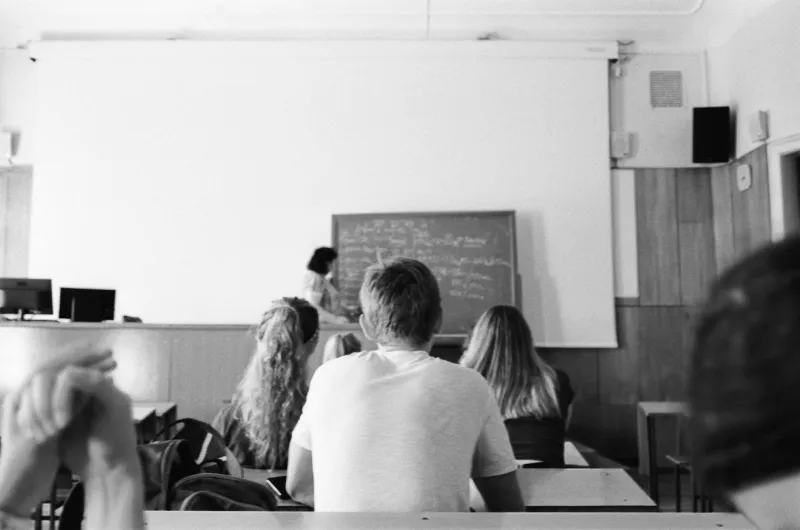
Every Friday afternoon in Mrs. Henderson's fifth-grade classroom in Topeka, Kansas, circa 1962, the same ritual unfolded. Twenty-eight students would stand beside their wooden desks, hands clasped behind their backs, ready for the weekly recitation. "Kansas — Topeka. Kentucky — Frankfort. Louisiana — Baton Rouge." Forty-eight more states to go, and heaven help the child who stumbled on "Massachusetts — Boston" or mixed up the Dakotas.
 Photo: Topeka, Kansas, via s2-oglobo.glbimg.com
This wasn't punishment or busy work. For generations of American students, memorization was the foundation of education, the cognitive equivalent of physical exercise. Teachers understood something that seems almost quaint today: if information lived only in books, it might as well not exist when you needed it most.
"We memorized because we had to," recalls Robert Chen, now 73, who attended elementary school in San Francisco during the 1950s. "There were no calculators, no internet, no smartphones. If you couldn't multiply 7 times 8 in your head, you were stuck. If you didn't know that Albany was the capital of New York, you looked ignorant."
 Photo: San Francisco, via media.cntraveler.com
The Multiplication Table Martyrs
American classrooms once echoed with the rhythmic chanting of mathematical facts. "Two times two is four, two times three is six, two times four is eight..." Students would recite these sequences until they became automatic, embedding arithmetic deep in their neural pathways. Teachers called it "drilling," and they meant it literally — boring holes in young minds and filling them with essential knowledge.
The memorization extended far beyond numbers. Students learned the Gettysburg Address by heart, recited poems by Longfellow and Frost, and could rattle off the names of every U.S. president in chronological order. They memorized the periodic table, the dates of major battles, and the capitals of countries most of them would never visit.
"I can still recite 'Paul Revere's Ride' from start to finish," says Margaret O'Sullivan, a retired teacher from Boston. "Learned it in seventh grade, 1959. 'Listen, my children, and you shall hear / Of the midnight ride of Paul Revere...' It's been sixty-four years, and I've never forgotten a word."
The Cognitive Gymnasium
Educators of the pre-digital era believed that memorization served a purpose beyond simply storing facts. They viewed it as mental calisthenics, a way of strengthening the mind's ability to retain and recall information. Students who could memorize poetry, they argued, developed better language skills. Those who drilled arithmetic facts freed up mental space for complex problem-solving.
The theory wasn't entirely wrong. Modern neuroscience has confirmed that memorization does create lasting changes in brain structure, strengthening neural pathways and improving overall cognitive function. But in the 1950s and 1960s, teachers didn't need scientific studies to tell them what they observed daily: students who had memorized their times tables could tackle algebra more confidently, and those who knew historical dates could better understand cause and effect.
"We called it 'mental furniture,'" explains Dr. Patricia Williams, who taught elementary school for thirty-seven years before retiring in 1995. "The idea was to furnish young minds with basic facts they could draw upon for the rest of their lives. You can't think critically about history if you don't know when things happened. You can't write poetry if you've never memorized any."
The Great Forgetting
The shift away from memorization began gradually in the 1970s and accelerated through the following decades. Educational reformers argued that rote learning was outdated, that students should focus on critical thinking and problem-solving rather than mindless repetition. The rise of calculators made arithmetic memorization seem obsolete. The internet promised to make all factual knowledge instantly accessible.
By the 1990s, many American schools had largely abandoned systematic memorization. Students were encouraged to "look it up" rather than commit information to memory. The emphasis shifted from knowing facts to knowing how to find them. Teachers praised creativity and analysis while viewing memorization as an antiquated relic of authoritarian education.
"We threw the baby out with the bathwater," admits Dr. Williams. "There were legitimate criticisms of how memorization was taught — too much drill and kill, not enough context or meaning. But instead of improving the methods, we abandoned the practice entirely."
The Smartphone Revolution
The final nail in memorization's coffin came with the smartphone revolution. Starting in 2007, Americans began carrying devices that could instantly answer any factual question. Why memorize state capitals when Google Maps could tell you instantly? Why learn multiplication tables when every phone had a calculator?
The change was swift and total. Within a decade, the assumption that educated people should know basic facts by heart had virtually disappeared. Students who couldn't multiply 8 times 7 without reaching for their phones were no longer considered deficient — they were considered normal.
"My students today are brilliant problem-solvers and creative thinkers," says Jennifer Martinez, a high school English teacher in Denver. "But ask them to recite a poem or give you the dates of World War II, and they look at you like you're speaking ancient Greek. They genuinely don't understand why anyone would memorize something they can look up."
What We Lost in Translation
The decline of memorization has brought undeniable benefits. Students today have access to more information than any previous generation could imagine. They can fact-check claims instantly, explore topics in depth, and make connections across vast databases of knowledge. The democratization of information has been one of the great achievements of the digital age.
Yet something subtle but significant was lost in the transition. When facts live only in external devices, they exist in isolation from each other. A student who looks up the date of the Civil War and then immediately looks up the invention of the telephone may never realize that these events were separated by only eleven years — a connection that might spark insights about technology and social change.
"There's a difference between knowing something and knowing about something," explains cognitive scientist Dr. James Chen (no relation to Robert). "When information is memorized, it becomes part of your mental landscape. You can make spontaneous connections, see patterns, and draw analogies that you'd never discover through Google searches."
The Memory Divide
Today's America is split between two cognitive generations. Older Americans who grew up before the internet often possess vast stores of memorized knowledge — poetry, historical facts, mathematical relationships — that they can access instantly. Younger Americans have developed different skills: rapid information retrieval, digital literacy, and the ability to navigate complex online environments.
Neither approach is inherently superior, but they represent fundamentally different relationships with knowledge. The memorization generation treats facts as personal possessions, part of their intellectual identity. The Google generation views information as a shared resource, accessible to all but owned by none.
The Pendulum Swings Back
Recently, some educators have begun questioning whether the pendulum swung too far away from memorization. Studies showing the cognitive benefits of learning poetry by heart have gained attention. Schools experimenting with "knowledge-rich" curricula — which include systematic memorization of core facts — have reported improvements in student achievement.
"We're starting to realize that you can't think critically about nothing," says Dr. Williams. "Students need a foundation of shared knowledge to build upon. When everyone has memorized the same poems and historical facts, they can communicate more effectively and make deeper connections."
The challenge for modern educators is finding the right balance — preserving the cognitive benefits of memorization while embracing the possibilities of digital information access. The goal isn't to return to the rigid drilling of the 1950s, but to recognize that some knowledge is worth carrying in our heads rather than our pockets.
In an age when any fact is just a tap away, the question isn't whether we can remember everything — it's whether we should remember anything at all. The answer may determine not just how we learn, but how we think.