Thumbtacks and Identity: The Bedroom Wall as Your First Social Profile
Somewhere around age thirteen, most American kids faced a decision that felt enormous at the time. You'd saved up your allowance, or maybe sweet-talked a parent into a trip to Spencer Gifts or the mall poster shop, and now you were standing in front of a spinning rack of glossy prints trying to figure out: Who am I, exactly?
That question — and the wall space you used to answer it — was once the most honest form of self-expression a young person had.
The Wall That Took Work
Choosing a poster wasn't passive. You couldn't scroll through infinite options and double-tap the ones that resonated. You had to walk somewhere, flip through physical prints, hold them up, squint, and decide. Then you had to carry the thing home in a cardboard tube, figure out where it was going to live, and commit. Thumbtacks went in. Tape went up. And there it was — your personality, declared to anyone who walked through your door.
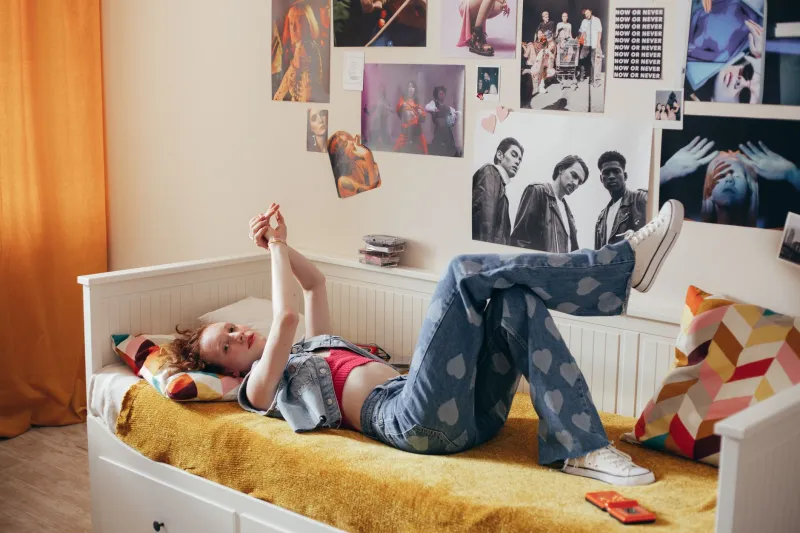
For most American teenagers from the 1970s through the early 2000s, bedroom walls were dense, layered, and personal in a way that's genuinely hard to replicate digitally. A Michael Jordan poster overlapping a Nirvana print, half-covered by a cut-out from a skateboarding magazine, with a Far Side calendar tacked in the corner. Each piece told a story about a specific moment in time — the band you discovered at fourteen, the athlete you idolized at sixteen, the movie that wrecked you at seventeen.
Nothing on that wall got there by accident. Every square inch was chosen.
The Permanence Was the Point
Here's what's easy to forget: removing a poster left a mark. Tape pulled paint. Thumbtack holes stayed. There was a mild but real cost to changing your mind, which meant you thought harder before you committed. If you put up a poster of a band, you were making a statement that would last at least a few months, probably longer.
That friction forced a kind of intentionality. You weren't curating in real time. You were making slow, considered declarations about what mattered to you — and then living with them long enough to really figure out if they still did.
Friends who came over could read your walls like a biography. Parents could tell when something shifted. A new band appearing meant something. An old poster coming down meant something else. The wall was a conversation, even when you weren't talking.
What the Algorithm Replaced
Today, identity curation happens constantly, invisibly, and without friction. Spotify knows your taste better than you do. TikTok has profiled your sense of humor within forty-eight hours of download. Instagram's Explore page quietly maps your aesthetic preferences and serves them back to you in a loop.
None of this requires a decision. That's the whole design.
A teenager's bedroom today might be almost entirely bare — not because they have no interests, but because those interests live on a screen that closes when company comes over. Their personality is rich and layered, but it's housed in apps rather than on walls. It's invisible to anyone standing in the room.
And unlike the thumbtacked poster, the digital version can be updated, deleted, or reversed in seconds. There's no paint damage. No commitment. No moment where you have to hold something up and say, yes, this is me.
The Curation That Cost Something
There's a reason people talk about their old bedroom walls with a specific kind of nostalgia. It's not just sentimentality for the posters themselves — it's for the version of self-knowledge that came from making slow, physical choices about identity.
When you picked a poster, you were doing real work. You were deciding what mattered enough to stare at every morning when you woke up. You were building a visual autobiography that didn't shift based on what was trending or what an algorithm thought would keep you engaged.
And maybe most importantly — you were wrong sometimes, in ways you had to sit with. The band you loved at fourteen that embarrassed you by sixteen was still up there, fading slightly at the edges, a little monument to who you used to be.
The Wall Doesn't Lie
There's something worth recovering in the idea that self-expression should cost a little something. Not money necessarily, but attention. Thought. The willingness to say this is what I'm about and leave it up long enough to find out whether you meant it.
The bedroom wall couldn't be A/B tested. It didn't adjust based on engagement metrics. It just sat there, honest and permanent, telling your story to anyone who looked.
Algorithms are better at knowing what you clicked on yesterday. But a thumbtacked poster? That knew who you were trying to become.