The Little Book That Kept You Honest: What We Lost When Calendars Learned to Remind Themselves
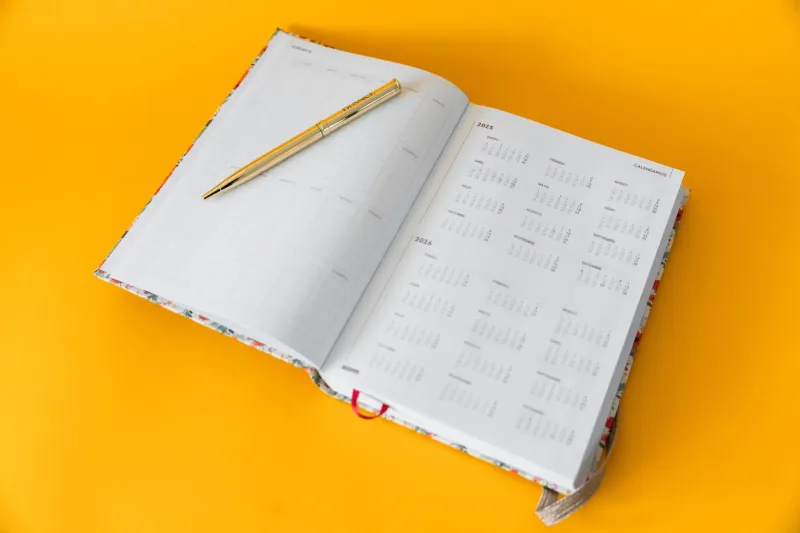
Somewhere in a drawer in your parents' house — or maybe your grandparents' — there's probably a small, worn book with a year stamped on its cover. The pages inside are dense with handwritten entries. Doctor's appointments. Birthday dinners. Car service. A note to call someone back on a Thursday. The ink is faded, the handwriting slightly rushed in places, careful in others. That book was a record of a life, managed by the person actually living it.
We don't keep those books anymore. And most of us haven't stopped to wonder what that actually means.
The Deliberate Act of Writing It Down
Through most of the twentieth century, Americans tracked their time on paper. The formats varied — pocket diaries, desk blotters, leather-bound planners, the humble spiral-bound appointment book from the drugstore — but the logic was universal. If something mattered enough to remember, you wrote it down. And writing it down was itself a kind of commitment.
There was a cognitive cost to every entry. You had to flip to the right week, scan what was already there, physically inscribe the information, and then — critically — close the book and carry it with you. None of this was automatic. The effort required was proportional to the importance of what you were scheduling. A dentist appointment in six weeks meant you had to think forward six weeks, picture your life then, decide it fit, and record it deliberately.
That friction wasn't a flaw. It was a feature.
Psychologists call this "elaborative encoding" — the idea that information you process more deeply gets stored more reliably. When you wrote an appointment down, you were doing more than logging data. You were rehearsing it. Connecting it to context. Giving it weight. Studies on memory consistently show that handwriting something improves recall compared to typing it, let alone having a device ping you about it.
The appointment book, in other words, was also a memory-training device. It just never got credit for that.
The Notification Economy
Today's calendar apps are marvels of engineering. Google Calendar, Apple Calendar, Outlook — they sync across every device you own, send you reminders at customizable intervals, schedule meetings automatically by scanning your availability, and even suggest travel time based on traffic. You can share your calendar with a spouse, a boss, or a whole team. The coordination overhead that used to consume real administrative effort has been compressed to almost nothing.
The efficiency gains are genuine and significant. Nobody serious is arguing we should go back to paper.
But there's a subtler story underneath the convenience. When your calendar manages itself, your relationship with time changes in ways that are easy to miss. You stop projecting forward. You stop holding your schedule in your head as an active mental model. Instead, you wait for the device to tell you where to be next. The calendar becomes less a tool you use and more a system you obey.
This isn't hypothetical. Researchers studying what they call "cognitive offloading" — the practice of outsourcing mental tasks to external tools — have found that while offloading can free up mental bandwidth, it can also erode the underlying skill. People who rely heavily on GPS, for instance, show reduced activity in the hippocampus during navigation. The same principle applies to time management. When the machine handles it, the brain stops bothering.
What Intentionality Actually Felt Like
Ask anyone who kept a paper planner seriously — and plenty of people still do — and they'll tell you something consistent: looking at a full week on paper forces a reckoning that a screen doesn't. When you can see, at a glance, that Tuesday is already packed and you've penciled in three things for Thursday morning, you make different decisions. You feel the weight of your commitments in a way that a scrollable digital list doesn't quite replicate.
There was also something socially meaningful about the physical calendar. The family calendar on the kitchen wall wasn't just logistical — it was a shared document of collective life. Kids could see when Dad had a work trip. Parents could see when the school play was. The visibility was built into the format. Everyone in the household was, in a loose sense, oriented toward the same future.
Digital calendars can be shared, technically. But shared digital calendars require everyone to opt in, stay synced, and actually check them. The kitchen wall required nothing except existing on the kitchen wall.
The Cost of Frictionless Time
Here's the uncomfortable question the efficiency argument tends to skip: if you never have to remember anything, what happens to your sense of your own time?
There's growing evidence that our perception of time passing is tied to how actively we engage with it. Psychologists who study time perception have found that rich, varied experiences — ones that require attention and deliberate navigation — make time feel fuller in retrospect. Passive, automated experiences blur together. The weeks where nothing demanded your real attention tend to disappear from memory.
A calendar you maintain yourself is a form of active engagement with your own life. Choosing what to prioritize, deciding what fits, physically recording the things that matter — these are small acts of authorship. They add up.
The notification ping, by contrast, is passive. It happens to you.
Moving Forward With Eyes Open
None of this is an argument for nostalgia. Digital calendars are genuinely useful, and the coordination they enable — across time zones, across households, across entire organizations — would have been unimaginable to the person filling in that pocket diary in 1974.
But the clock delta here is worth noticing. We didn't just change our tools. We changed our relationship with time itself — from something we actively managed to something that manages us. The old appointment book asked you to show up with intention. Today's calendar asks you to show up when buzzed.
Maybe the real question isn't which system is more efficient. It's which one makes you feel more like the author of your own schedule — and which one just makes you a well-organized passenger.