Behind the Counter and Into Your Life: The Pharmacist Who Knew More Than Your Doctor
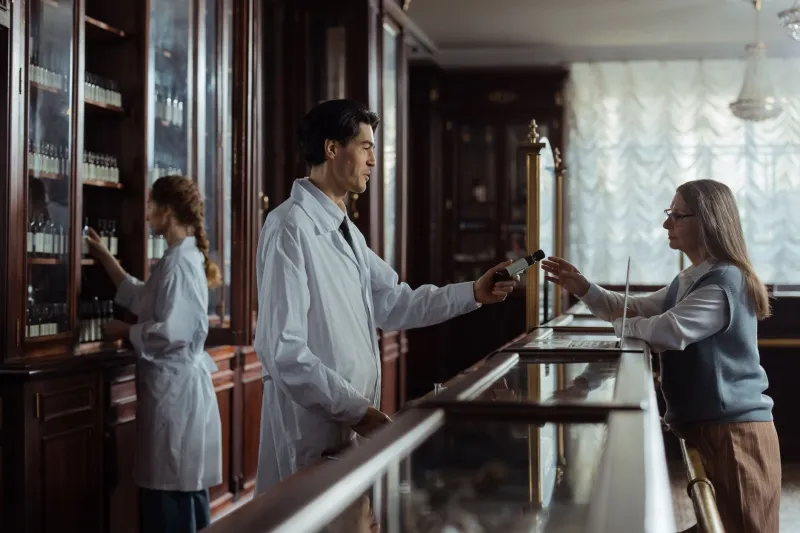
Somewhere between the amber pill bottles and the hand-labeled paper bags, there was a person who actually knew you. Not your insurance ID number. Not your date of birth used for verification. You — your kids' ear infections, your mother's heart condition, the medication your father couldn't tolerate because of that incident back in '62. The neighborhood pharmacist was, for much of the 20th century, one of the most quietly powerful figures in American community life. And we barely noticed when that role disappeared.
The Corner Drugstore as Community Anchor
Picture a Tuesday afternoon in 1965. A woman walks into a drugstore on the corner of a street she's walked down her whole life. The pharmacist — maybe a man in his fifties with reading glasses perpetually pushed up on his forehead — looks up and greets her by name before she even reaches the counter. He already knows her husband is recovering from surgery. He asks how the recovery is going. He mentions, almost in passing, that the new medication her doctor prescribed can interact with something she's already been taking, and maybe she should check back with the physician before starting it.
That conversation wasn't a formal consultation. It wasn't billed. It was just... how things worked.
In mid-20th century America, independent pharmacies were fixtures of neighborhood life in the same way barbershops and hardware stores were. According to the National Community Pharmacists Association, independent pharmacies once made up the vast majority of the country's dispensing operations. These weren't chain outlets staffed by rotating employees — they were often family-owned businesses where the same pharmacist served the same families across generations.
The pharmacist occupied a unique position in the healthcare ecosystem. Doctors were busy, sometimes intimidating, and appointments weren't always easy to come by. The pharmacist was accessible. You could walk in without scheduling anything, ask a question over the counter, and get a straight answer from someone who had a full mental picture of your household's medical history stored in their head — and in a handwritten card index behind the counter.
The Card File and the Human Algorithm
Before electronic health records, before cloud-based pharmacy management systems, there was the physical patient file. Pharmacists maintained handwritten records of every customer's prescriptions, allergies, and known sensitivities. Some kept this information in index card boxes. Others had ledger books. A few particularly organized operations had early filing systems that would look charmingly primitive today.
But here's the thing: those systems worked because the person maintaining them cared about the person the file represented. The pharmacist wasn't processing records — they were thinking about people they knew. That distinction matters more than it might sound.
When a new prescription came in that conflicted with something already on file, the pharmacist caught it not because software flagged it, but because they remembered. Memory, in this context, was a form of care.
When Efficiency Replaced Familiarity
The shift didn't happen overnight. Through the 1970s and especially the 1980s, chain pharmacies began expanding aggressively across America. Names like Walgreens, Eckerd, and Revco started appearing in strip malls and shopping centers, offering competitive pricing and extended hours. For consumers, the appeal was real — more locations, lower costs, and eventually drive-through windows that let you collect your medication without leaving your car.
By the 1990s and 2000s, pharmacy benefit managers — the middlemen between insurers and pharmacies — had restructured much of how prescriptions were filled and paid for. Volume became the metric that mattered. A high-performing pharmacy location wasn't measured by customer relationships; it was measured by prescriptions dispensed per hour.
The pharmacists didn't disappear, of course. Their clinical training actually deepened over this period — modern pharmacists are highly educated professionals with doctorate-level credentials. But the conditions of their work shifted dramatically. A pharmacist at a busy chain location might process hundreds of prescriptions in a single shift, leaving little time for the kind of unhurried conversation that once defined the role.
Automated refill systems, robotic dispensing units, and app-based prescription management have since taken over much of what used to require a human interaction. You can now refill a prescription without speaking to anyone at all. Whether that's progress depends entirely on what you think a pharmacy is for.
What the Automation Got Right — and What It Missed
Fairness demands acknowledging what changed for the better. Modern pharmacy systems are extraordinarily good at catching dangerous drug interactions — far more reliably than any individual's memory. Electronic records can follow you across states and providers. Automated reminders have genuinely improved medication adherence for millions of people with chronic conditions. These aren't small things.
But something real was lost when the counter became a transaction point rather than a meeting place. Studies on medication adherence consistently show that patients who have a trusted relationship with a healthcare provider — any healthcare provider — are more likely to follow through on treatment plans. The informal check-in, the quick question answered without an appointment, the reassurance from someone who actually knew your history: these things had measurable value that efficiency metrics never quite captured.
There's also the matter of who gets left behind when systems become fully automated. Elderly patients navigating complex medication schedules. Non-English speakers trying to understand dosage instructions. People managing multiple chronic conditions across different prescribers. These are exactly the people who benefited most from having a knowledgeable human being on the other side of the counter — and exactly the people most likely to struggle when that human is replaced by a phone app.
The Clock Still Ticking
A small revival is underway, quietly. Independent pharmacies have held on in communities where relationships still carry weight. Specialty compounding pharmacies have built practices around personalized care. Some states have expanded pharmacists' authority to provide direct patient consultations and even prescribe certain medications — a recognition that the clinical knowledge was always there, just underutilized.
But the golden age of the neighborhood druggist who knew your family by name? That particular clock doesn't run backward.
What it leaves behind is a useful question: when we optimized the pharmacy for speed and scale, did we accidentally optimize away the part that made people healthier? The amber bottle still tells a story. We just stopped having someone around who knew how to read it.