Nobody Knew Where You Were at 3pm on a Tuesday — And That Was Fine
Somewhere in America right now, a person is declining a meeting request because their calendar shows them as "busy" — and they're being asked to explain what, exactly, they're busy with. Not by their boss. By a coworker. Or maybe an app that's trying to find a better slot.
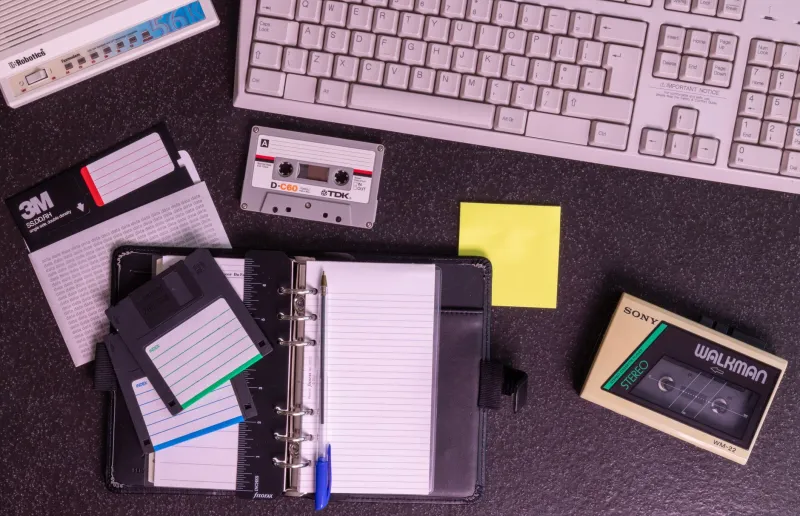
That would have been an absurd conversation forty years ago. Your schedule was yours. It lived in a small planner, maybe a leather-bound one you kept in your bag or your desk drawer. It wasn't synced to anything. It wasn't visible to anyone unless you physically showed it to them. And the idea that someone could ping you at 7pm to ask why you hadn't responded to a message you clearly had time to read — well, that concept simply didn't exist.
We gave all of that up so gradually that most of us never noticed it happening.
The Planner as a Private Document
Through the 1970s, '80s, and most of the '90s, personal scheduling was a genuinely intimate act. You wrote things down for yourself. A dentist appointment on Thursday. Dinner with the Garcias on Saturday. A reminder to call your sister back. These notes were shorthand that only you needed to decode, because only you were ever going to read them.
Office scheduling existed, of course — secretaries managed executive calendars, and conference rooms got booked through physical sign-up sheets on the wall. But even in corporate environments, the idea that a colleague could pull up your personal availability on a screen and drop a meeting into your day without asking first would have seemed presumptuous at best, invasive at worst.
Your time was the one resource that was understood to be yours. You allocated it. You reported on it when necessary. But the default assumption was privacy, not transparency.
When Google Calendar Changed the Rules
The shift started slowly with early workplace software in the late 1990s — Lotus Notes, Microsoft Exchange — tools that let organizations share calendars internally. At first it was optional, a convenience for scheduling large meetings without the back-and-forth of phone calls.
Then smartphones arrived, and calendar apps became standard. Then came the expectation that if you had a smartphone, your calendar was always accessible. Then came the assumption that if you were reachable, you were available — or at least required to explain why you weren't.
By the mid-2010s, calendar sharing had moved beyond the workplace. Couples synced schedules. Parents used shared family calendars. Friends coordinated through apps that showed everyone's free windows. The planner went from a private document to something closer to a public ledger.
And with that shift came something subtler: the slow disappearance of unscheduled time that felt genuinely protected.
The Autonomy You Didn't Know You Had
Here's what people who grew up before always-on scheduling often describe: a sense of real ownership over their days. Not because their lives were less busy — plenty of people in 1985 had jam-packed schedules — but because the hours between commitments felt like theirs to spend without justification.
You could take a long lunch and nobody was watching a calendar block to see when you'd return. You could have an unproductive afternoon and it wouldn't show up as a gap in a shared visibility tool. You could make plans with a friend without those plans appearing in any system that your employer, your family, or an advertising algorithm could see.
There's a term researchers use now: calendar surveillance. It's the phenomenon where the mere visibility of your schedule — to colleagues, to apps, to the platforms that monetize your behavioral data — changes how you use your time. You start filling gaps not because you need to, but because empty blocks feel like a statement. Like evidence of something.
The 'Off-Duty' Problem
Maybe the most significant casualty of visible scheduling culture is the concept of being genuinely off-duty. Not just unavailable — actually off the grid in a way that required no explanation and generated no anxiety.
When your schedule lived only in your own handwriting, evenings and weekends were structurally separate from work. There was no mechanism by which a coworker could see that you were free at 6pm on a Friday and drop something into that window. The separation wasn't just cultural; it was architectural.
Today, calendar apps don't distinguish between personal time and professional time unless you manually configure them to. And even when you do, the notification layer beneath the calendar — email, Slack, Teams, text — routes around whatever boundaries you try to set. Visibility has become the default, and privacy requires active, ongoing effort.
According to a 2023 survey by the American Psychological Association, nearly 44% of US workers reported feeling pressure to respond to work communications outside of working hours. That pressure doesn't come from nowhere. It comes, in part, from the fact that everyone can see everyone else's schedule — and absence now reads as a choice that needs defending.
What It Means to Own Your Time
None of this is an argument for going back to paper planners, or for pretending that shared scheduling tools don't have real value. Coordinating across teams and time zones is genuinely easier now. Families with complicated logistics actually benefit from visibility. The technology solved real problems.
But something got lost in the trade. There was a version of daily life where your time was assumed to be yours until you chose to share it. Where a blank afternoon wasn't a scheduling opportunity for someone else. Where the hours between your obligations belonged to you in a way that required no setting, no toggle, no boundary-setting conversation with your manager.
The clock delta between then and now isn't just about the tools. It's about the assumption underneath them — the quiet, foundational belief that your schedule is your own business.
We used to start from that assumption. Now most of us have to fight our way back to it.