When Night Was Actually Night: What We Traded for the Light
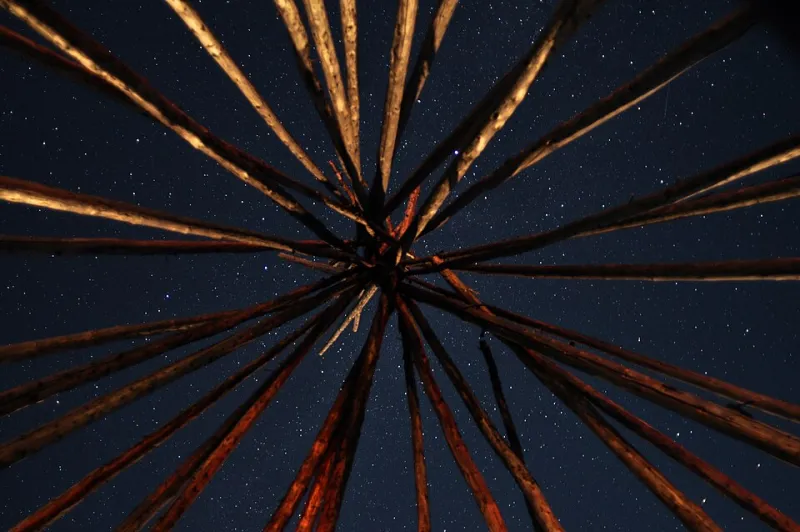
Photo: Carl Young, CC BY-SA 4.0, via Wikimedia Commons
There's a photograph taken from the International Space Station that shows the continental United States at night. It looks like a circuit board — dense webs of amber and white light tracing every highway, suburb, and city grid. It's genuinely beautiful. It's also a portrait of something we've lost without ever holding a funeral for it.
True darkness. The kind that used to fall over this country every single evening, without exception.
The Way Night Used to Feel
Before Thomas Edison's first commercial power stations began flickering to life in the early 1880s, nighttime in America was profoundly, physically dark. Rural families worked by candlelight or kerosene lanterns that threw small, warm halos of amber across a kitchen table and left everything else in deep shadow. In cities, gas lamps lined the streets, but they were islands — pools of light separated by long stretches of genuine black.
The darkness wasn't just an inconvenience. It was a signal. When the light went, the day went with it. People ate earlier, gathered closer, and went to bed when the sun did — not because they were tired by modern standards, but because the absence of light made the alternative feel almost impossible. Historians who study sleep patterns from pre-industrial diaries have found that many Americans actually slept in two distinct phases, waking for an hour or two in the middle of the night to read, talk, or pray before sleeping again. The night had a texture to it, a rhythm that no longer exists.
Even after electrification spread through American homes in the early twentieth century, the light was modest. A single incandescent bulb in the center of a room cast maybe 60 watts of warm, imprecise light — enough to see by, not enough to fool your body into thinking it was noon.
The Long Brightening
The transformation didn't happen overnight, but it accelerated dramatically after World War II. Suburban expansion brought streetlights to every cul-de-sac. Retail culture demanded that storefronts stay lit after closing. The interstate highway system stitched together a network of illuminated corridors across the country. By the 1970s, the idea of true darkness had already become a rural luxury.
Then came LEDs.
Modern LED lighting is extraordinarily efficient, which is exactly why it's everywhere. It's cheap to run, so municipalities install more of it. It's bright and blue-white in tone, which makes it feel clean and safe. Parking lots, sports stadiums, billboards, office towers, and residential porches all glow with the same relentless clarity. Today, roughly 99 percent of Americans live under skies bright enough to qualify as light-polluted. About a third of the country — and more than half of Europeans, for comparison — can no longer see the Milky Way from where they live.
Think about that for a second. The Milky Way. The smear of stars that every human being who ever lived could look up and see on a clear night. Gone, for most of us, not because of clouds, but because of parking lot lights.
What the Dark Did for Us
This isn't purely a stargazing complaint. The loss of darkness has measurable consequences for human biology that researchers are still working to fully understand.
The human body runs on a circadian rhythm — an internal clock calibrated over millions of years to the cycle of light and dark. Darkness triggers the release of melatonin, a hormone that signals the body to wind down, lower its core temperature, and prepare for restorative sleep. Artificial light at night — especially the blue-spectrum light from LED bulbs, phone screens, and televisions — suppresses melatonin production. The body gets confused. It thinks it's still afternoon.
The American Academy of Sleep Medicine has linked chronic light exposure at night to increased rates of insomnia, metabolic disruption, and even certain cancers. A 2019 study published in JAMA Internal Medicine found that women who slept with a television or light on in the room were significantly more likely to gain weight over a five-year period. The light wasn't just keeping them awake. It was quietly rewriting their physiology.
Beyond biology, there's something harder to measure but just as real: the psychological experience of darkness as a place where the mind could rest. Before the glow of screens and streetlights seeped under every curtain, nighttime enforced a kind of mental stillness. You couldn't scroll. You couldn't work efficiently. You sat with your thoughts, or you slept. The dark was, in a strange way, a protected space.
What We Gained — and What the Trade Cost
None of this is an argument for going back to kerosene lamps. The benefits of artificial lighting are enormous and obvious. Crime rates in well-lit areas drop. Accidents on roads and in workplaces decrease. People with shift-work jobs can function. The extension of the productive day has added immeasurable economic value to American life.
But the trade was real, and we made it without fully understanding the terms.
We traded the Milky Way for a lit parking lot. We traded two-phase sleep and the meditative quiet of genuine darkness for a world that never fully powers down. We traded a biological rhythm that shaped human behavior for fifty thousand years for the ability to scroll Instagram at 1 a.m. under a sky that glows orange even when the sun is long gone.
There are people trying to reclaim pieces of it. Dark sky preserves exist in places like Utah, Arizona, and rural Texas, where communities have agreed to restrict outdoor lighting so that residents and visitors can experience what the night sky actually looks like. The International Dark-Sky Association now certifies towns and parks that meet strict lighting standards. It's a niche movement, but it's growing.
Maybe that's the tell. When the simple act of standing in darkness becomes a destination — something you have to drive hours to experience — you know how much has changed. The night used to come to you, every single evening, without fail. Now we have to go looking for it.