Pen to Page, Week by Week: The Lost Power of Deciding What Your Time Was Worth
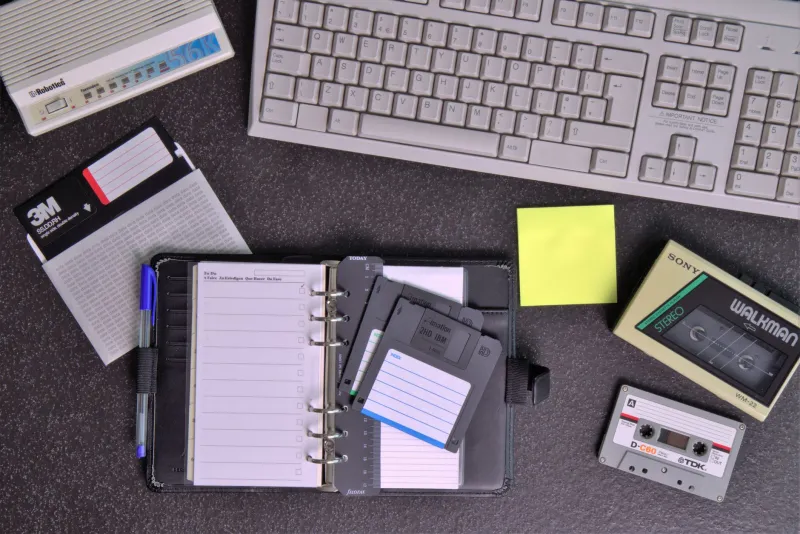
There's a moment that used to happen in offices and kitchens across America, usually on a Sunday evening or first thing Monday morning. Someone would open a book — a real one, with pages and a cracked spine and maybe a coffee ring on the cover — and spend a few minutes thinking through the week ahead. Writing things down. Crossing things out. Deciding, with some deliberation, what was going to happen and what wasn't.
It wasn't glamorous. It was just a planner. But that small ritual was doing something that our current systems, for all their sophistication, genuinely cannot replicate.
The Object Itself
The day planner had a golden era in America that ran roughly from the mid-1970s through the late 1990s. Brands like Day-Timer, Franklin Planner, and At-A-Glance became household names. Executives carried leather-bound systems that organized their entire professional lives. Families tacked oversized wall calendars in kitchens, filling the squares with doctor's appointments, school events, and Little League schedules in different-colored pens.
These weren't just organizational tools. They were physical records of a life in motion. Flip back three months in an old Franklin Planner and you'd find a to-do list from a Tuesday in October, a phone number scrawled in the margin, a meeting that got rescheduled twice. The object accumulated history. It had weight.
The act of writing something down — pressing pen to paper, forming the letters, filling in the time slot — required a decision. Not a tap. Not a drag-and-drop. A decision. You had to mean it.
The Discipline of Finite Space
Here's what nobody talks about when they compare paper planners to digital calendars: paper runs out of room.
That constraint was a feature, not a bug. A day had a fixed amount of space on the page. When it was full, it was full. You couldn't just stack meetings on top of each other with a five-minute buffer and call it a schedule. The physical reality of the page imposed a kind of honesty. If you wanted to add something, you had to look at what was already there and make a trade.
Saying yes to something on paper meant looking at what you were potentially saying no to. That's a fundamentally different cognitive experience than accepting a calendar invite that your phone quietly absorbs and files.
Digital calendars don't push back. They don't run out of space. They'll accept every meeting request, stack every obligation, and send you a notification two minutes before each one — as if the problem were ever about remembering, rather than about choosing.
The Weekly Review That Actually Happened
Franklin Covey, whose planning system sold millions of units in the 1980s and '90s, built an entire philosophy around what they called the weekly review — a dedicated block of time to look at the week ahead, set priorities, and align your schedule with what actually mattered to you.
The thing is, the paper planner made this review almost unavoidable. You had to physically open the book. You had to look at the week. You had to write things in. There was no auto-populate, no recurring event that appeared without your involvement. The planner demanded regular engagement.
For a lot of Americans, that weekly sit-down with the planner was when decisions got made. Not reactive decisions, but intentional ones. I'm going to block Tuesday afternoon for that project. I'm going to leave Friday evening open because I've been running too hard. The planner was where you had an argument with yourself about your own priorities — and usually came out the other side with something resembling clarity.
What the Algorithm Took Over
Digital calendars arrived gradually and then all at once. Palm Pilots in the late '90s. Outlook syncing across corporate networks in the early 2000s. Google Calendar integrating with email, automatically converting "let's meet Thursday at 2" into a calendar event before you'd even replied. iCloud syncing your schedule across your phone, laptop, and watch in real time.
The efficiency gains were real and undeniable. Shared calendars transformed how teams coordinated. Automatic reminders eliminated the forgotten dentist appointment. The ability to reschedule with a few taps removed genuine friction from daily life.
But something else happened too. The calendar stopped being a place where you made decisions and became a place where decisions accumulated. Invites arrived and got accepted. Recurring meetings multiplied. The week filled up not because you chose to fill it, but because the system made it easy for other people to fill it for you.
The planner had required you to be the author of your schedule. The digital calendar, over time, made it very easy to become the audience.
The Surprising Revival
It's worth noting that paper planners never actually died. Leuchtturm1917, Moleskine, and Hobonichi notebooks have built devoted communities of users — many of them young professionals who grew up entirely in the digital age and found their way back to paper specifically because of what the screen couldn't offer.
The bullet journal movement, which exploded in the 2010s, is essentially a DIY paper planning system that asks users to design their own organizational structure. Its popularity isn't nostalgia. It's a response to something missing.
What people are looking for, it turns out, is the friction. The pause. The moment between having an idea and committing to it, where you have to pick up a pen and decide whether it's actually worth writing down.
The clock has always moved forward. But some of us are learning that the pace at which we fill it is still, at least partly, up to us.