One Square Per Day: The Paper Calendar That Made You Choose
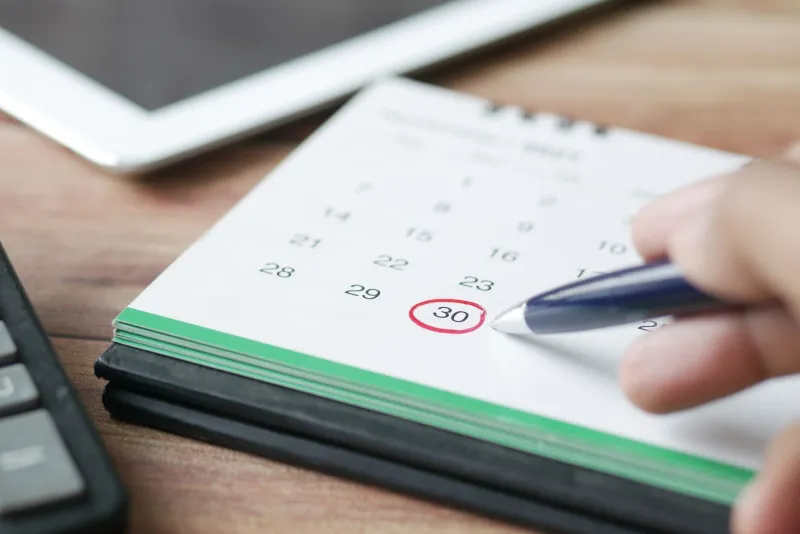
There was a small ritual that played out in millions of American homes every January. Someone — usually Mom, sometimes Dad, occasionally both of them arguing about it — would hang a fresh calendar on the kitchen wall. Maybe it came free from the insurance agent. Maybe it was the one with the covered bridges of New England. Either way, it was the year, laid flat, waiting to be filled in with whatever mattered enough to write down.
That last part is the key. Whatever mattered enough to write down.
The Friction That Forced Intention
The paper appointment book wasn't just a scheduling tool. It was a filter. When you had to physically locate a pen, flip to the right week, find the right time slot, and commit ink to paper, you made a small but genuine decision: this thing is real. You were, in a quiet way, ratifying your own life choices.
The pocket planner — that slim, leather-covered staple of the briefcase and purse — had a similar weight to it. Professionals kept them religiously. A dentist appointment got written in. A lunch with a client. Your kid's school play. The annual physical. These weren't entries in a database. They were declarations. The limited space on the page meant you couldn't say yes to everything, because there was literally no room.
Family wall calendars worked the same way, just more communally. When the Hendersons of suburban Ohio needed to coordinate four people's schedules, someone picked up a marker and wrote it on the calendar in the kitchen. Everyone could see it. Everyone walked past it. The refrigerator was the original shared cloud.
The Upgrade That Changed Everything
Digital calendaring arrived quietly and then all at once. Microsoft Outlook brought it into the office in the late '90s. Palm Pilots gave executives the thrill of tapping a stylus against a tiny screen. Then the iPhone arrived in 2007 and the calendar became something that lived in your pocket, synced to your laptop, integrated with your email, and eventually started suggesting appointments before you'd even confirmed them.
Google Calendar, iCal, Calendly — the tools got better, smarter, and more frictionless with every iteration. Today, someone can send you a link that shows your open time slots and books itself without a single phone call. A meeting request lands in your inbox, you click accept, and it appears on every device you own simultaneously. From a pure logistics standpoint, it's extraordinary.
And yet.
The Paradox of Perfect Visibility
Here's the strange thing that happened when scheduling became effortless: we started scheduling more. A lot more.
When saying yes to something required no effort — just a click — the cost of saying yes dropped to nearly zero. Calendars that once had white space started filling up. Then overfilling. Then requiring color-coding systems and apps-within-apps just to manage the complexity. The tool designed to organize our time somehow made our time feel more chaotic.
Researchers who study cognitive load have a term for this: the paradox of choice meets the paradox of convenience. When everything is easy to add, nothing feels like a real commitment until it's too late to back out. The paper calendar, by contrast, made you commit before the day arrived. The act of writing it down was itself a small act of ownership.
There's also something worth noting about visibility. Digital calendars give you perfect, real-time visibility into every obligation you've accepted. You can see, in horrifying detail, a Tuesday in March where you have seven meetings and no lunch break. The paper planner would have stopped you from booking that Tuesday the moment the page got crowded. The digital calendar just shows you the disaster and sends you a reminder.
What the Waiting Room Taught You
There's another dimension to this shift that doesn't get talked about enough: the appointment book taught patience in a way that digital scheduling doesn't.
When you called your doctor's office in 1987 and they said, "We can fit you in on the fourteenth," you wrote it down and you waited. You didn't get a text reminder three days out, a push notification the morning of, and a "we're ready for you" ping when you arrived. You remembered because you'd written it down. You showed up because you'd made a real commitment to a real person on the other end of a phone call.
That small friction built a kind of memory muscle. People remembered their own schedules. They tracked their own obligations. The calendar wasn't doing the work for them — it was helping them do the work themselves.
Something Worth Keeping
None of this is an argument against digital calendars. The ability to sync schedules across a family, coordinate across time zones, and get a reminder before an important call is genuinely useful. The clock moved forward, and most of the movement was good.
But there's a reason that paper planners have seen a quiet comeback in recent years. The Hobonichi Techo. The Passion Planner. The simple Moleskine weekly diary. These aren't nostalgia products — they're corrections. People who feel overwhelmed by their digital calendars are reaching for something that forces them to choose, to prioritize, to write it down and mean it.
One square per day. That was the deal. Make it count.