When Taking Pictures Meant Taking Time: The Lost Ritual of Film Photography
When Taking Pictures Meant Taking Time: The Lost Ritual of Film Photography
In 1985, if you wanted to capture your kid's birthday party, you had exactly 24 chances to get it right. Miss the shot? Too bad. Run out of film? The party's over. And even if you nailed every frame, you wouldn't see the results for at least a week.
Today, we take more photos in two minutes than most families took in an entire year back then. But somewhere between the film canister and the smartphone camera, we didn't just change how we capture moments — we completely transformed our relationship with memory itself.
The Economics of Every Click
Thirty-five years ago, photography was expensive. A roll of 24-exposure film cost around $3, plus another $8 for developing — roughly $30 in today's money just to see two dozen pictures. That single birthday party could easily cost what we now spend on a month of Netflix.
This wasn't just about money; it was about intention. Every frame mattered because every frame cost something. Photographers would spend minutes composing a shot, checking the light, waiting for the perfect expression. The phrase "spray and pray" didn't exist because you literally couldn't afford to spray.
Compare that to today: the average American takes 20 photos per day, mostly without thinking. We shoot first and delete later, if we bother looking at them at all. The financial barrier that once made photography precious has vanished entirely.
The Darkroom Democracy
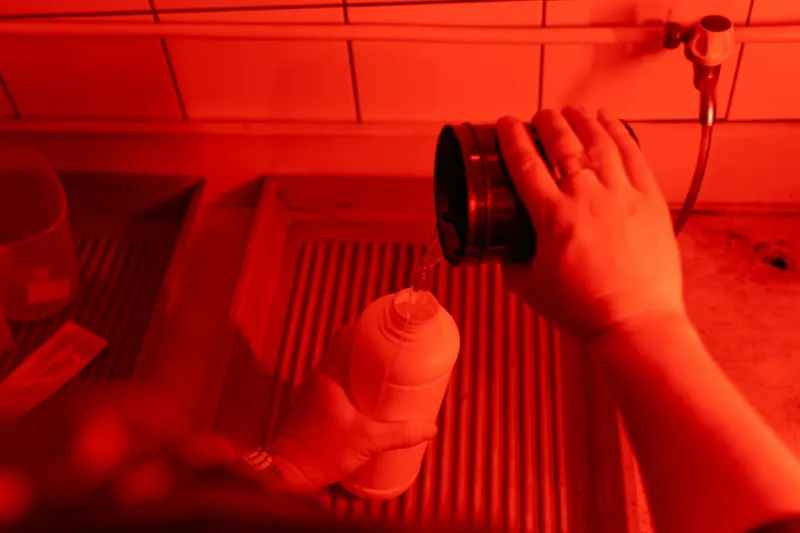
Before Walgreens and CVS became photo labs, serious hobbyists developed their own film in converted bathrooms and basement darkrooms. These spaces were temples of patience — red-lit sanctuaries where time moved differently and every step mattered.
The process was almost ceremonial. You'd measure chemicals to precise temperatures, time every stage to the second, and watch images slowly materialize in developer baths. A single printing session could take hours, and mastering techniques like dodging and burning required genuine skill.
This wasn't just about the technical process — it was about delayed gratification on a scale that's almost incomprehensible today. You might not see your vacation photos for weeks after returning home. The anticipation was part of the experience, and the reveal carried weight that no Instagram story can match.
When Mistakes Were Permanent
Film photography was unforgiving in ways that shaped behavior. Overexpose a shot? It's ruined forever. Camera shake? That's $1.25 down the drain. Forget to advance the film? You just shot a double exposure that might be artistic genius or complete garbage.
These limitations created a different kind of photographer. People learned to understand light, to anticipate moments, to work within constraints. Wedding photographers carried multiple camera bodies because you couldn't just "take another one." Every professional shot was backed by years of experience and technical knowledge.
Today's computational photography handles most of these challenges automatically. Portrait mode mimics shallow depth of field. HDR balances impossible lighting. Night mode captures scenes that would have been invisible to film. We've democratized professional-quality results, but we've also eliminated the learning curve that once separated snapshots from art.
The Social Media Shift
Perhaps the biggest change isn't technical — it's social. Film photographs lived in albums, on mantels, in wallets. They were physical objects with weight and permanence. Families would gather around photo albums, telling stories about each carefully preserved moment.
Now our photos exist in cloud servers, viewed once on small screens before disappearing into digital archives we'll never organize. We share them instantly with hundreds of people who scroll past in seconds. The photo itself has become less important than the immediate social validation it generates.
This shift has changed what we choose to photograph. Film era shots captured genuine moments — people actually living their lives. Today's photos are increasingly performative, staged for social media consumption rather than personal memory.
What We Lost in Translation
The convenience revolution in photography mirrors broader changes in American life. We've optimized for speed and volume over craftsmanship and intentionality. The result is simultaneously more and less — more images but fewer memories, more documentation but less meaning.
Film photography forced a different relationship with time itself. You couldn't know immediately if you'd captured the moment, so you had to be present for it. You couldn't take a hundred shots of the sunset, so you had to choose the right one. You couldn't delete mistakes, so you learned not to make them.
The Clock Delta Effect
The transformation from film to digital represents more than technological progress — it's a fundamental shift in how we experience and preserve our lives. We've gained incredible convenience and creative possibilities, but we've lost the deliberate patience that once made every photograph a small investment in the future.
Today's teenagers will never experience the anticipation of picking up developed photos, never feel the weight of a physical album, never understand why their grandparents took so few pictures but treasured each one. In gaining the ability to capture everything, we may have lost the wisdom of knowing what's worth capturing.
The darkroom is gone, but its lessons about patience, craft, and intentionality remain relevant in our instant-everything world. Sometimes the best technology isn't the fastest — it's the one that makes us slow down long enough to notice what we're actually trying to preserve.