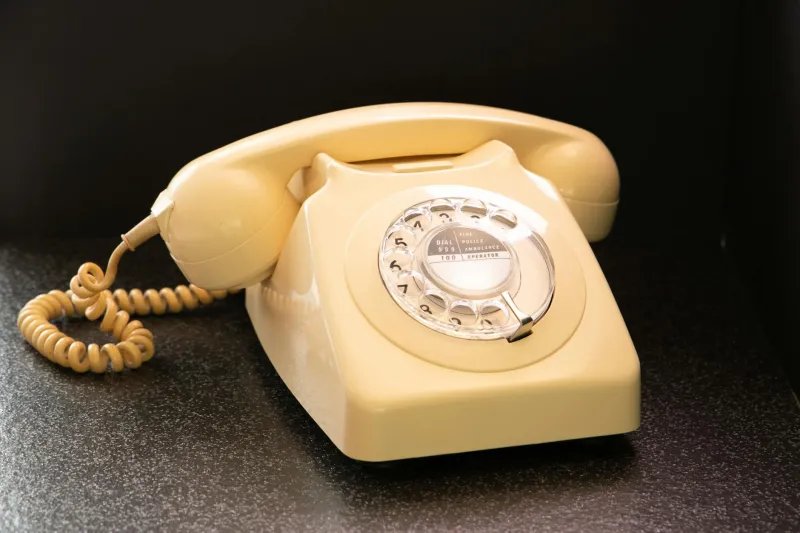
The Shared Secret of American Communication
Imagine picking up your phone to make a call and hearing Mrs. Henderson from down the street already deep in conversation with her sister about her husband's gambling problem. Welcome to the party line era, when privacy was a luxury most Americans couldn't afford and telephone conversations were community events whether you wanted them to be or not.
From the 1920s through the 1960s, millions of American households shared party lines—single telephone circuits that served multiple homes. Each household had a distinctive ring pattern, but anyone could pick up their receiver and listen in on any conversation happening on their line. And they did. Oh, how they did.
The Economics of Shared Secrets
Party lines weren't a design choice; they were an economic necessity. Running individual telephone lines to every home was prohibitively expensive, especially in rural areas where houses might be miles apart. The phone company's solution was elegant and intrusive: share the line, share the cost, share everything else that came with it.
Families paid a fraction of what a private line would cost, but the savings came with strings attached—strings that connected them to their neighbors in ways that seem almost unthinkable today. Your phone bill might list you as sharing with three other households, but you never knew who those households were until you started recognizing voices.
The Unwritten Rules of Telephone Etiquette
Party line culture developed its own complex social protocols. There was an unspoken agreement about conversation length—hog the line too long, and you'd face the wrath of neighbors who needed to make their own calls. Some lines had formal time limits; others relied on passive-aggressive sighing and throat-clearing from listening neighbors.
The polite fiction was that you wouldn't listen in on others' conversations. The reality was that everyone did, creating a strange form of consensual surveillance. Neighbors learned to speak in code about sensitive topics or simply accepted that their business would become everyone's business.
When Gossip Had Infrastructure
The party line was gossip's golden age. Mrs. Patterson might learn about the Johnsons' financial troubles not through deliberate snooping, but simply by picking up the phone at the wrong (or right) moment. This accidental intelligence network meant that neighborhood news traveled at the speed of sound, literally.
Some listeners became known quantities—the neighbor who always seemed to be on the line when you picked up, whose breathing you could hear in the background. These weren't necessarily malicious people; they were often lonely individuals for whom other people's conversations provided companionship and connection to the wider world.
The Emergency Network
Party lines created an informal emergency response system that modern 911 services struggle to match. When someone had a medical emergency or needed help, multiple households would hear the distress call simultaneously. Neighbors would coordinate responses in real-time, with some calling for ambulances while others rushed over to help.
This system saved lives precisely because it violated privacy. The community surveillance that felt intrusive during normal times became a lifeline during emergencies.
Romance and Intrigue on the Wire
Young people growing up with party lines learned early that private conversations were a myth. Teenage romance played out under the ears of neighbors, creating a strange form of community courtship supervision. Parents might learn about their children's relationships through neighborhood intelligence networks rather than direct conversation.
Some couples turned this to their advantage, using the party line as a way to make their relationships public without formal announcements. Others developed elaborate codes and meeting arrangements to maintain some semblance of privacy.
The Death of Shared Listening
As the economy grew and technology improved, private lines became standard. By the 1970s, party lines were mostly a rural phenomenon, and by the 1980s, they were virtually extinct. The transition happened gradually, then suddenly—like so many technological shifts, it seemed inevitable only in retrospect.
Families who upgraded to private lines often felt a strange sense of loss alongside the relief. The house felt quieter, more isolated. The constant low-level awareness of neighbors' lives disappeared, replaced by the pristine silence of a dedicated line.
Digital Isolation
Today's communication technology has swung entirely in the opposite direction. We carry personal communication devices that encrypt our messages, hide our locations, and create digital barriers between us and everyone else. Even family members in the same house often communicate through private text messages rather than shared conversation.
The contrast is stark: we've gone from involuntary community surveillance to voluntary digital isolation. Where party lines forced intimacy, smartphones enable solitude. Where neighbors once knew too much about each other, they now often know nothing at all.
What We Learned from Shared Lines
The party line era taught Americans that privacy was negotiable, that community came with costs, and that knowing your neighbors' business wasn't necessarily a bad thing. It created a form of social accountability that modern life lacks—when everyone could hear your conversations, you thought more carefully about what you said and how you said it.
This wasn't just about technology; it was about a fundamentally different understanding of where individual rights ended and community interests began. The party line was democracy's most intimate expression: messy, intrusive, and surprisingly effective at keeping people connected.
In our rush toward perfect privacy and individual autonomy, we might have optimized away something valuable—the knowledge that we're all in this together, listening and being heard, sharing the same line through life.