The Two-Week Gamble: When Americans Bet Blind on Their Own Memories
The Envelope of Truth
Picture this: You've just returned from the family vacation of a lifetime. Two weeks in Yellowstone, your daughter's first steps captured on film, that perfect sunset over the Grand Canyon. But here's the catch — you won't know if any of it actually made it onto film for another 10 days.
This was the reality for generations of Americans who lived in what we might call the "photographic dark ages" — that stretch from the 1950s through the 1990s when taking a picture was just the beginning of a long, uncertain journey.
Every roll of film represented a gamble. Twenty-four or thirty-six chances to freeze time, with no way to know if you'd succeeded until long after the moment had passed. Americans would drop off their precious cargo at the local drugstore or mail it away to processing labs, then enter a state of suspended animation that today's instant-gratification generation simply cannot fathom.
The Ritual of Uncertainty
The process itself was a study in delayed gratification that would make a Buddhist monk proud. First came the careful rationing of shots — with only 24 exposures per roll, every click of the shutter carried weight. Birthday parties were choreographed around film conservation. "Wait, let me get everyone together for ONE picture," became the family photographer's rallying cry.
Then came the drop-off ritual. The yellow Kodak envelope, carefully filled out with your name and phone number, handed across the pharmacy counter like a lottery ticket. "Ready Tuesday after 3 PM," the clerk would promise, and Tuesday couldn't come fast enough.
But Tuesday was just the beginning. The real moment of truth came when you tore open that envelope, not knowing whether you'd find treasures or disasters. Maybe the entire roll would be overexposed from that one time you accidentally opened the camera back. Maybe your daughter's first birthday party existed only as a series of blurry, finger-covered disappointments.
When Chemistry Ruled the Day
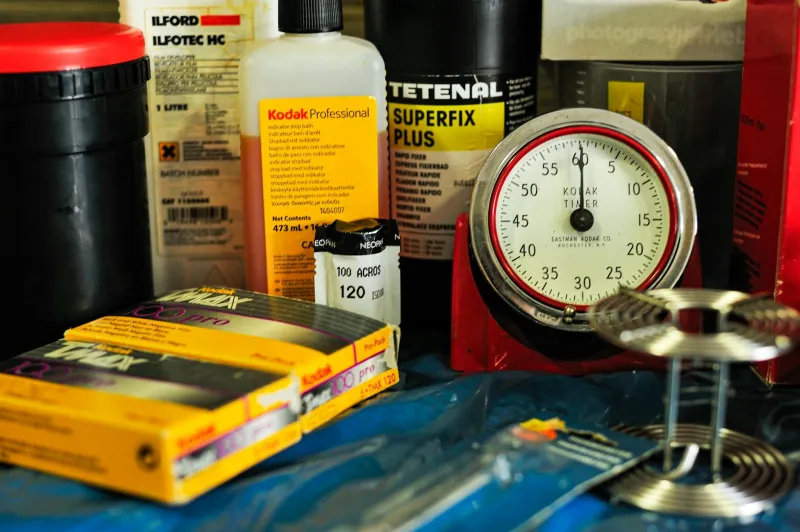
The magic — and the terror — lay in the chemistry. Deep in processing labs across America, your memories were being bathed in developer, stop bath, and fixer. Temperature mattered. Timing mattered. The phase of the moon probably mattered. One technician having a bad day could turn your wedding album into abstract art.
Americans learned to live with this uncertainty in ways that seem almost quaint today. Vacation photos weren't shared until weeks after you'd returned home. Family gatherings were documented with crossed fingers and whispered prayers to the photography gods. The phrase "I hope these turn out okay" became as common as "please pass the salt."
The One-Hour Revolution
Then came the 1980s and the miracle of one-hour photo. Suddenly, that two-week wait compressed into a single lunch break. Americans could actually know, on the same day they took pictures, whether Uncle Bob had his eyes closed in every single shot.
One-hour photo labs sprouted like mushrooms in strip malls across the country. The promise was intoxicating: drop off your film on your way to work, pick up your memories on your way home. The anxiety remained — that hour could feel like a lifetime — but at least the suffering was brief.
The quality wasn't always perfect. Those quick-processing machines sometimes produced photos with a distinctive, slightly washed-out look that became the aesthetic signature of the late 20th century. But speed trumped perfection. Americans had tasted instant gratification, and there was no going back.
The Weight of Waiting
What we lost in the transition to digital wasn't just the waiting — it was the weight that waiting gave to each image. When every photo carried the possibility of disaster, the ones that turned out well felt like small miracles. Families would gather around the kitchen table to examine each print, passing them carefully from hand to hand like sacred artifacts.
Bad photos weren't just deleted with a casual swipe — they were physical objects that had to be dealt with. Some families kept them anyway, creating albums filled with blurry landscapes and decapitated relatives that somehow became more precious over time.
The Digital Divide
Today, Americans take more photos in a single day than their grandparents took in a year. Every moment is captured, reviewed, edited, and shared before the next moment arrives. The uncertainty is gone, replaced by an endless stream of perfect, instantly gratified memories.
But something else disappeared in that transition: the anticipation that made photography feel magical. The nervous excitement of picking up an envelope of prints. The collective family experience of discovering which moments had been successfully preserved and which had been lost forever to the mysteries of chemistry and time.
The Last Roll
Somewhere in America, probably in a drawer or closet, sits the last roll of film that someone forgot to develop. It's been there for years, maybe decades, holding memories that no one will ever see. In our rush toward instant everything, we've created a generation that will never know the peculiar joy of photographic archaeology — of finding an old roll of film and wondering what secrets it might hold.
The two-week wait is over. The gamble is finished. But in winning the game of instant photography, we might have lost something harder to define: the understanding that some things worth having are worth waiting for, even when you're not sure they'll turn out at all.