The Lost Art of Knowing Where You Were
The Lost Art of Knowing Where You Were
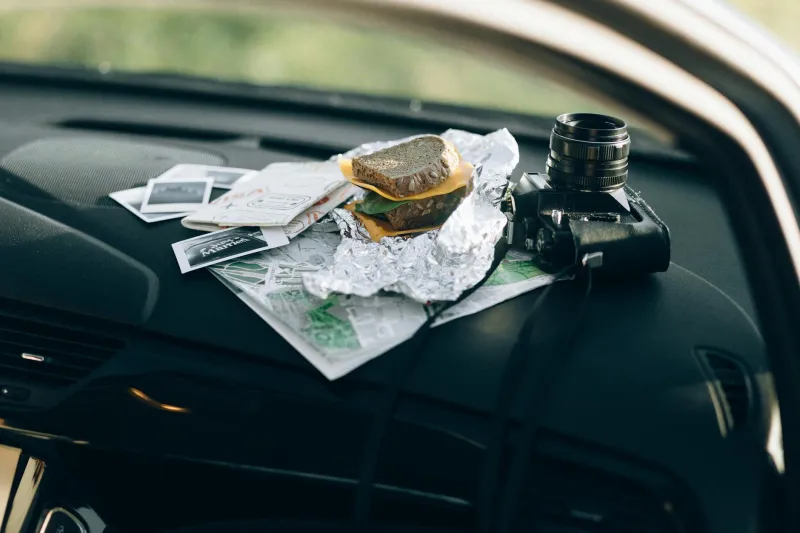
There used to be a ritual to getting anywhere unfamiliar. You'd spread the map across the kitchen table the night before — that enormous, accordion-folded thing that never quite folded back the same way twice — and trace the route with your finger. Highway numbers, exit names, landmarks. You'd write it on a notepad or, if you were particularly organized, fold the map to show just the relevant section and wedge it between the sun visor and the roof. Then you'd drive, and you'd pay attention, because there was no voice to correct your mistakes.
That world is gone now. And most of us are too busy following the blue dot to notice what went with it.
When the Gas Station Was the Google Maps
For much of the twentieth century, navigation was a genuinely social activity. Gas stations didn't just sell fuel — they sold local knowledge. Attendants (yes, the kind who came out to your car, pumped your gas, and cleaned your windshield) were often the most reliable source of real-time directions in any given region. "Take Route 9 north until you hit the old grain elevator, then turn left at the Methodist church" was practical, specific guidance — and it worked, because the person giving it knew exactly where the grain elevator and the church were.
Road maps were everywhere. Gas stations gave them away for free — a promotional gesture that also happened to be genuinely useful. Rand McNally sold road atlases that lived permanently in the back seat or the glove compartment. AAA members received custom TripTik booklets: spiral-bound, strip-by-strip route guides printed to your specific trip that you'd flip through page by page as you drove. It was navigation as a physical, tactile process.
And people were good at it. Not everyone, not perfectly, but the basic skill of reading a map — understanding scale, orientation, the relationship between roads and geography — was a normal adult competency. You learned it because you had to.
The MapQuest Moment
The first major disruption wasn't GPS. It was the internet.
MapQuest launched in 1996 and within a few years had become one of the most visited websites in America. For the first time, you could type in an address and receive turn-by-turn printed directions. The printout became its own cultural artifact: multiple pages, sometimes stapled, always slightly too small to read comfortably while driving, occasionally wrong in ways that sent you twenty miles in the wrong direction.
But MapQuest directions were still a preparation tool. You read them before you left. You internalized the route, at least partially. You still had to navigate — the paper just helped you plan. If you took a wrong turn, you had to think your way back, because the paper didn't update.
That small friction mattered more than anyone realized at the time.
GPS and the Surrender of Spatial Awareness
Turn-by-turn GPS navigation arrived in consumer vehicles in the early 2000s and on smartphones at scale after 2007. Within a decade, it had fundamentally changed how Americans move through space.
The statistics are striking. Multiple studies have found that regular GPS users show measurably reduced activity in the hippocampus — the part of the brain responsible for spatial memory and navigation — compared to people who navigate without assistance. A 2020 study from McGill University found that people who relied heavily on GPS showed faster cognitive decline in that region over time. London taxi drivers, famously required to memorize the city's entire street network before licensing, have measurably larger hippocampal regions than average. Use it or lose it, as it turns out, applies to your internal compass.
Practically speaking, the effects are visible everywhere. Ask someone who grew up post-smartphone to describe the route from their home to a friend's house two miles away, without looking at their phone. Many can't do it. Not because they're incapable, but because they've never had to encode that information — the phone always handles it. The knowledge was never laid down in the first place.
What We Actually Gained
None of this is an argument for going back. GPS navigation is genuinely, unambiguously useful in ways that deserve acknowledgment.
It has made driving in unfamiliar cities dramatically less stressful. It routes around traffic in real time — something no paper map could ever do. It has almost certainly prevented accidents caused by drivers trying to read directions while moving. It's made road trips accessible to people who might otherwise have been too anxious about getting lost to attempt them. For delivery drivers, rideshare operators, and emergency services, it's transformed what's operationally possible.
The technology is brilliant. The question is just what happened to the skill it replaced.
The Trade-Off Nobody Voted On
Every generation makes trade-offs with technology. We stopped memorizing phone numbers when contacts lists arrived. We stopped doing mental arithmetic when calculators became universal. Navigation is just the latest in a long line of cognitive tasks that we've offloaded to machines — and like those others, we barely noticed it happening.
The difference, maybe, is that navigation was more than a skill. For a lot of Americans, knowing how to read a map and find your way through an unfamiliar place was tied up in something larger — a sense of confidence in physical space, an understanding of how the country was laid out, a feeling of genuine competence behind the wheel.
There's something worth sitting with in the image of a family pulled over at a rest stop, the dad unfolding a map the size of a tablecloth while the kids argue in the back seat. It was inefficient, occasionally maddening, and sometimes led to spectacular wrong turns. It also meant that when you arrived, you actually knew where you'd been.
These days, the blue dot gets you there. You just might not be able to tell anyone how.