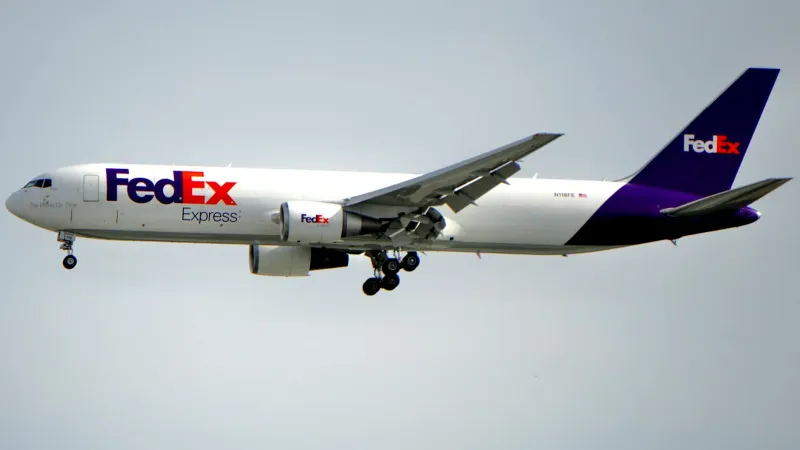
When Tomorrow Became Today
On April 17, 1973, Federal Express delivered 186 packages to 25 cities overnight. It sounds unremarkable now, but at the time, the idea that you could send something from New York and have it arrive in Los Angeles the next morning seemed like science fiction. Americans were accustomed to waiting weeks for mail, days for telegrams, and accepting that distance meant delay.
FedEx didn't just create a new shipping service—they created a new relationship between Americans and time itself.
The Pre-Express Economy
Before overnight delivery, American business moved at the speed of the postal service. Important documents took days or weeks to reach their destinations. Companies built their operations around these delays, maintaining larger inventories, planning further ahead, and accepting that urgent meant "maybe by next week."
The phrase "the check is in the mail" became a cultural touchstone precisely because everyone understood that mailing something was where urgency went to die. Businesses kept carbon copies of everything because once you put something in the mail, you lost control of when—or if—it would arrive.
The Memphis Miracle
Fred Smith's insight was deceptively simple: instead of trying to connect every city directly to every other city, route everything through a single hub. Memphis became the overnight delivery capital of America, a place where packages from everywhere converged every night before scattering back across the continent by morning.
This hub-and-spoke model seemed inefficient—why fly a package from Boston to Los Angeles via Memphis?—but it was revolutionary. By accepting a geographic detour, FedEx created temporal compression that seemed to violate the laws of physics.
The Psychological Shift
The real revolution wasn't logistical; it was psychological. Once Americans experienced overnight delivery, their expectations about everything else began to change. If a package could cross the country in 12 hours, why did banking transactions take three days? If documents could arrive by morning, why did government processes take weeks?
Overnight delivery became proof that delay was often a choice, not a necessity. It revealed how much of American life moved slowly not because it had to, but because no one had figured out how to make it faster.
The Ripple Effect
The overnight delivery revolution rippled through every sector of the economy. Manufacturers could reduce inventory by shipping parts just-in-time rather than stockpiling for weeks of potential delays. Law firms could serve papers across the country overnight. Medical labs could process samples from distant hospitals and return results by morning.
Entire industries reorganized around the new temporal reality. The concept of "rush delivery" evolved from a rare emergency service to a standard business practice. Companies began promising not just overnight delivery, but specific morning delivery times: by 10:30 AM, by noon, by end of business day.
The Compression Continues
What seemed miraculous in 1973—overnight delivery—became merely adequate by the 1990s. Two-day shipping emerged as the new standard, then same-day delivery, then two-hour delivery windows. Amazon Prime turned expedited shipping from a luxury service into a consumer expectation.
Each acceleration made the previous speed feel sluggish. Customers who once marveled at overnight delivery began to feel impatient about two-day shipping. The miracle became mundane, then inadequate.
The Cost of Speed
This relentless acceleration came with hidden costs that Americans are only now beginning to calculate. The overnight delivery economy requires massive infrastructure: cargo planes flying mostly empty across the country every night, distribution centers in every major city, delivery trucks crisscrossing neighborhoods multiple times per day.
The environmental impact is staggering. The carbon footprint of overnight delivery is exponentially higher than standard shipping, but this cost remains largely invisible to consumers who see only the convenience.
The Patience Deficit
Perhaps more importantly, the overnight delivery revolution contributed to what psychologists now recognize as a cultural patience deficit. Americans have become conditioned to expect instant gratification not just for packages, but for everything: information, entertainment, communication, even personal transformation.
The generation that grew up with overnight delivery struggles with anything that can't be accelerated. Traffic jams feel intolerable, buffering videos cause genuine frustration, and waiting in line seems like a personal insult.
When Fast Isn't Fast Enough
Today's delivery wars have reached almost absurd extremes. Companies compete on delivery windows measured in hours, not days. Drone delivery promises to shrink that window to minutes. The logical endpoint seems to be instantaneous materialization—the Star Trek transporter as the ultimate delivery service.
But each increment of speed delivers diminishing returns of actual value while requiring exponentially greater resources. The difference between overnight and two-day delivery can be crucial; the difference between two-hour and one-hour delivery rarely is.
The Time Trap
The overnight delivery revolution created a time trap that Americans are still caught in. We've optimized for speed at the expense of almost everything else: cost, environmental impact, worker welfare, and our own peace of mind. We've become a nation of people who can get almost anything by tomorrow morning but struggle to wait for anything.
Recalibrating Expectations
The most radical act in modern America might be choosing slower shipping. Not because you have to, but because you can. Because sometimes the thing you ordered today doesn't need to arrive tomorrow. Because the planet and your patience might benefit from remembering that not everything needs to move at the speed of overnight delivery.
FedEx proved that Americans could have almost anything by morning. The question we're still learning to ask is whether we should.
The overnight delivery revolution compressed time and expanded possibility in ways that seemed purely beneficial in 1973. Fifty years later, we're discovering that some compressions create their own pressures, and that the fastest way isn't always the best way forward.