Blind Forecasts: When Americans Couldn't Know What the Weather Would Be
The World Without Warning
On August 31, 1935, a massive hurricane made landfall in the Florida Keys with almost no warning. The barometric pressure had been dropping, yes. The sky had been darkening. But there was no official forecast, no emergency alert, no evacuation order. A train carrying veterans and workers was trapped on a bridge when the storm hit. The surge swept it off the tracks. More than 400 people died.
In the aftermath, people didn't ask why they hadn't been warned. They asked how anyone could have warned them. Weather forecasting, as a science, barely existed. You could observe what was happening. You could notice patterns. But you couldn't predict what would happen next with any meaningful accuracy. If a hurricane was coming, you found out when you saw it.
This wasn't incompetence. It was physics. To predict the weather, you need data—lots of it, collected simultaneously from across a region. You need to understand the mathematical relationships between pressure, temperature, wind, and humidity. You need to process that data quickly. Before satellites, before computers, before radio networks, none of that was possible.
The Farmer's Dilemma
For most Americans through the 1950s, weather was a matter of educated guessing. Farmers relied on almanacs—publications that compiled historical weather patterns and astronomical data to suggest what might happen. The Farmer's Almanac, first published in 1818, was treated almost like scripture. People planned their entire growing season around its predictions.
But almanacs were essentially statistical hunches. They worked sometimes. They failed spectacularly other times. A farmer might plant based on a prediction of a dry summer, only to watch torrential rains destroy the crop. Or they'd prepare for frost and get a warm spell. The margin between a good prediction and a bad one was the difference between profit and ruin.
So farmers also relied on folk wisdom—the kind passed down through generations and encoded in sayings. "Red sky at night, sailor's delight. Red sky at morning, sailors take warning." "If the oak before the ash, we're in for a splash. If the ash before the oak, we're in for a soak." These observations had enough basis in atmospheric physics to be useful occasionally, but they were also just as likely to be coincidence.
Sailors used similar methods. They read the horizon, the color of the clouds, the behavior of seabirds. They could sense when a storm was coming, sometimes hours in advance. But "sense" is not the same as "know." Ships still got caught in storms they didn't see coming. Fishing fleets still lost men because the weather turned faster than anyone expected.
The Shift Begins
The first real improvement came with radio. In the 1920s and 1930s, the U.S. Weather Bureau began broadcasting daily forecasts—predictions based on observations collected from weather stations across the country. Suddenly, people could tune in and hear what meteorologists thought would happen.
But the forecasts were crude. They covered large regions with vague language. "Cooler with possible precipitation" wasn't much more precise than looking at the sky. And they were often wrong. The Great Blizzard of 1967 caught the East Coast almost entirely by surprise because the forecast predicted only "light snow." Meteorologists simply didn't have enough data or computational power to see what was coming.
The real transformation began in the 1960s with weather satellites. Tiros-1, launched in 1960, was the first satellite designed to photograph clouds from space. Suddenly, meteorologists could see entire weather systems forming. They could track hurricanes in real time. They could watch cold fronts move across the continent.
But seeing wasn't the same as predicting. That required computers. By the 1970s, the National Weather Service had begun using mainframe computers to run mathematical models of the atmosphere. These models weren't perfect—they were constrained by computing power and the resolution of available data—but they were dramatically better than anything that had come before.
From Guessing to Precision
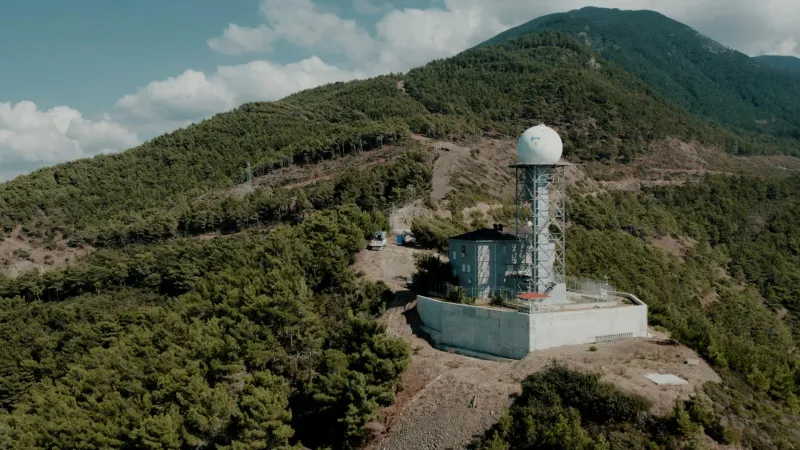
The improvement accelerated through the 1980s and 1990s. Weather satellites became more sophisticated. Computer models became more refined. Doppler radar, which could detect precipitation and rotation within storms, became standard at weather stations. By the 2000s, meteorologists could predict not just whether it would rain, but when, where, and how much.
Today, the contrast is almost absurd. You can pull out your phone and see an hour-by-hour forecast for the next week. You can see radar imagery updated every few minutes. You can receive alerts on your watch when a severe thunderstorm is about to reach your location. The precision is so routine that we barely notice it.
A weather forecast from 1960 might have said "Chance of rain tomorrow." A weather forecast from 2024 says "78% chance of rain between 2:15 PM and 4:45 PM, with rainfall expected to total 0.3 inches." The difference isn't just in detail—it's in the fundamental shift from uncertainty to precision.
What Changed for Ordinary Americans
For farmers, this shift was transformative. Modern agricultural decisions are made with weather data that's accurate five to ten days out. A farmer can make decisions about pesticide application, irrigation, or harvesting based on forecasts that are reliable enough to bet the season on. The risk hasn't disappeared, but it's been dramatically reduced.
For travelers, the change is equally profound. In 1960, planning a road trip meant hoping for good weather. You might pack for rain, but you couldn't really know. Today, you can time your departure to avoid a storm, or decide not to drive at all.
For everyone, the shift represents a fundamental change in humanity's relationship with the natural world. Weather is no longer something that happens to you. It's something you know about in advance. You can prepare, avoid, or plan around it. The surprise is gone.
The Invisible Revolution
We take this for granted now—so completely that it barely registers as a change. But a century ago, not knowing what the weather would be was simply the human condition. You dealt with what came. You adapted. You survived or you didn't.
Now we live in a state of perfect meteorological knowledge. We know the forecast. We carry it with us. We check it obsessively.
It's one of technology's quietest victories: we've eliminated one of nature's fundamental uncertainties. And because it happened gradually, because the change was so complete, most of us have never really noticed what we gained—or paused to think about what it means that the sky no longer has any secrets.