The Living Room Library That Defined Smart
In 1975, owning a complete set of Encyclopedia Britannica meant your family was serious about knowledge. Twenty-four burgundy volumes, each one thick as a phone book, arranged in perfect alphabetical order on a dedicated shelf. They cost more than most families spent on groceries in three months, purchased through door-to-door salesmen who understood they were selling more than books — they were selling the promise of an educated household.
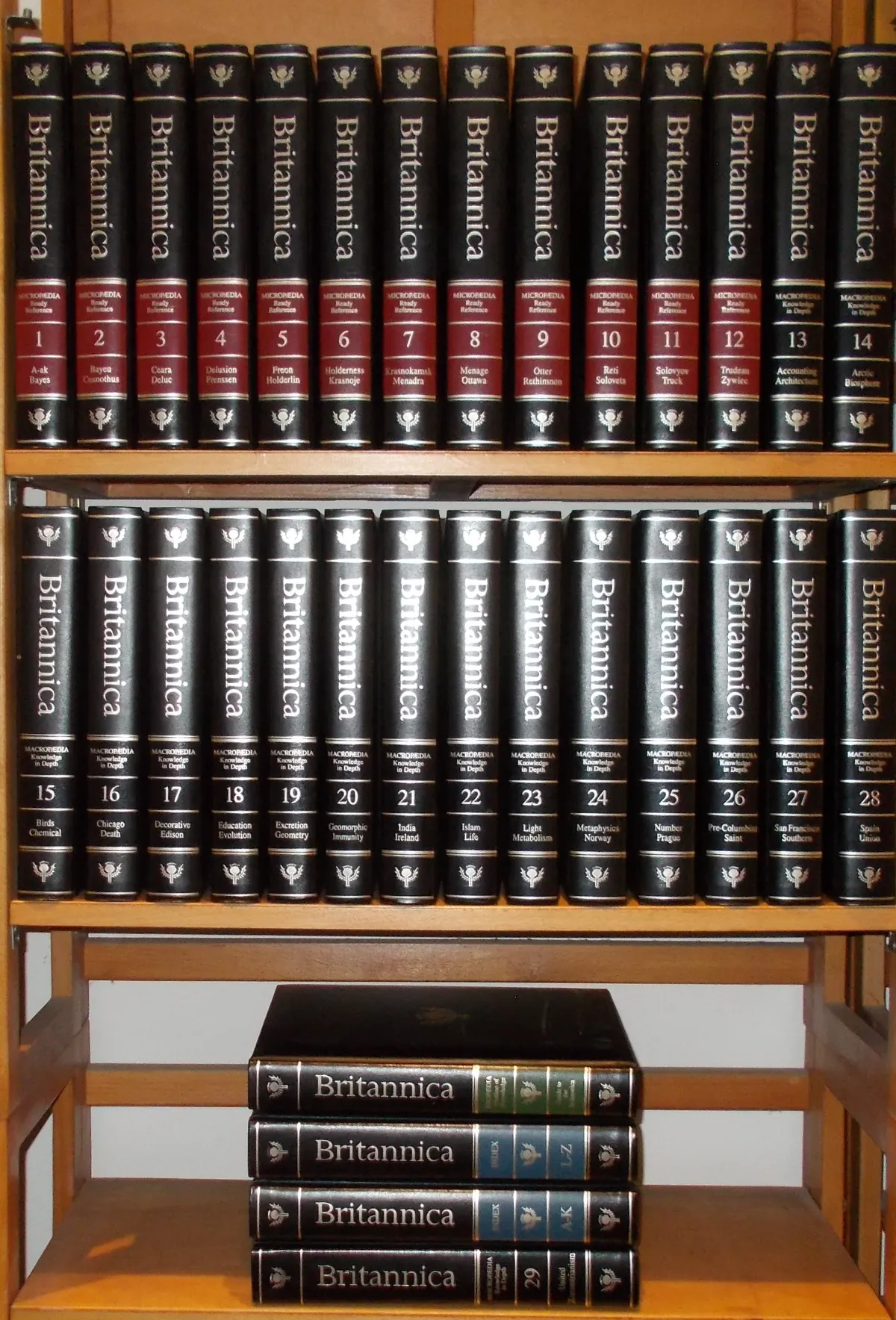 Photo: Encyclopedia Britannica, via pictures.abebooks.com
Those encyclopedias weren't just reference materials. They were furniture, status symbols, and the family's designated keeper of absolute truth. When a dinner table argument erupted about the population of Wyoming or the date of the Louisiana Purchase, someone would inevitably march to the bookshelf and return with Volume W or Volume L, settling the matter with the weight of printed authority.
When Facts Had Addresses
Every piece of information lived at a specific location. "Photosynthesis" was always on page 847 of Volume P, right between "Photography" and "Physics." "Baseball" occupied exactly three columns in Volume B, no more, no less. This geography of knowledge created a unique relationship with information — facts weren't just floating in some digital cloud, they had physical addresses you could visit.
Children learned to navigate this printed universe with the skill of experienced librarians. They knew that "United States" would be a massive entry spanning dozens of pages, while "Xerography" might get just a paragraph. The weight of each volume became familiar — Volume M was always the heaviest because it contained "Medicine," "Music," and "Mathematics."
Compare this to today's Wikipedia, where articles expand and contract in real-time, where "Baseball" might link to 847 related topics, and where the "simple" version of any entry might be longer than an entire encyclopedia volume from 1975.
The Ritual of Looking Things Up
Researching a school report meant physical labor. You'd pull down Volume D to read about dinosaurs, taking notes on index cards because you couldn't just copy and paste. The process was slow, deliberate, and surprisingly satisfying. Each fact felt earned because you'd had to hunt for it.
The encyclopedia's cross-references sent you on treasure hunts through multiple volumes. Reading about "World War II" would send you to "Hitler, Adolf" in Volume H, then to "Holocaust" in the same volume, then back to "Normandy" in Volume N. These journeys through the alphabet often led to accidental discoveries — you'd flip past "Narwhal" or "Nepal" and find yourself reading about something completely unrelated to your original search.
When Knowledge Had Limits
The most profound difference was the edge of the known world. When you reached the end of an encyclopedia entry, that was it. No "see also" links to infinite rabbit holes, no suggested articles, no user comments or edit histories. Just the authoritative conclusion of human knowledge on that topic, as of the copyright date.
This finitude created a different relationship with curiosity. If you wanted to know more about quantum physics than the six paragraphs in Volume Q provided, you had to go to the library, find a specialist book, or accept that some questions would remain unanswered until you were older and had access to university resources.
The Annual Update Anxiety
Encyclopedias aged like milk. The 1973 World Book contained no mention of the Watergate scandal's conclusion, no entry for "personal computer," and listed the population of cities that had grown by hundreds of thousands since the last printing. Families would agonize over whether to buy the expensive yearly supplements or spring for an entirely new set.
This built-in obsolescence taught American children that knowledge itself could become outdated. They learned to check copyright dates, to understand that "current" information might be several years old, and to accept that some facts would simply be wrong by the time they looked them up.
The Salesmen Who Sold Certainty
Encyclopedia salesmen were part of American folklore — smooth-talking door-to-door educators who could convince working-class families to spend $400 (about $2,000 today) on books they might open a dozen times a year. They sold more than information; they sold the idea that smart families owned encyclopedias, that educated children needed these tools, that knowledge was something you could purchase and display.
The payment plans made it possible: just $15 a month for two years, and your family would own "the sum of human knowledge." It was brilliant marketing for an era when information scarcity was real and Google was still twenty years away.
When Authority Meant Something
The encyclopedia's greatest power was its finality. When Encyclopedia Britannica said something, that settled it. There were no comments sections, no edit wars, no conflicting sources to weigh. The editorial board had spoken, and their word was literally bound in leather.
This created both comfort and limitation. Families trusted these books completely, but they also accepted that knowledge was something created by distant experts and delivered to ordinary people, not something ordinary people could contribute to or question.
What We Lost When Information Became Infinite
The shift from encyclopedias to search engines represents more than technological progress — it's a fundamental change in how Americans relate to knowledge itself. We've traded authority for accessibility, finitude for infinity, and certainty for the endless anxiety of never quite knowing if what we're reading is true.
Today's children will never experience the particular satisfaction of finding exactly what they were looking for in Volume R, or the discipline of taking notes because they couldn't just bookmark the page. They'll never know the weight of knowledge — literally — or the strange comfort of reaching the end of everything there was to know about pterodactyls.
In our rush to make all information instantly available, we may have lost something valuable: the idea that knowledge is worth paying for, worth waiting for, and worth the physical effort of seeking it out. The encyclopedia era taught Americans that some things were worth owning completely, even if you could only access them one volume at a time.